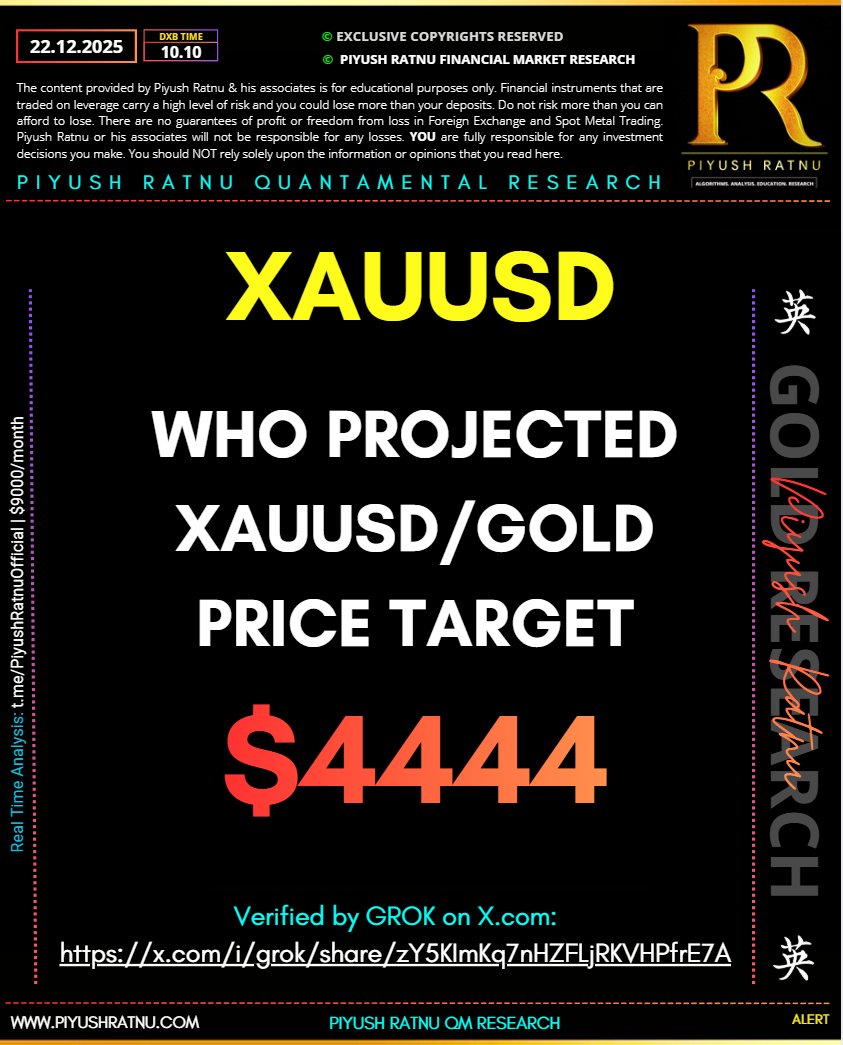
Key Parameters of Piyush Ratnu’s XAUUSD (Spot Gold) analysis
Piyush Ratnu’s $XAUUSD$ (Spot Gold) analysis is highly regarded in the retail trading community for its data-heavy, algorithmic precision. Unlike traditional bank analysts who focus on long-term macro trends, Ratnu’s “Quantamental” approach is built for tactical execution.
His high accuracy (verified at 85%–88.9%) is driven by the mapping of 130+ technical and fundamental parameters. Here are the key parameters he uses to achieve this:
1. Structural Parameters (SR MTF)
Ratnu uses a Support & Resistance Multi-Timeframe (SR MTF) framework. He doesn’t look at price in isolation but maps it across M5, M15, H1, and D1 simultaneously.
-
Psychological Clusters: He targets repetitive digit levels (e.g., $4,242, $4,343, $4,444). His research suggests that High-Frequency Trading (HFT) algorithms often “cluster” around these numbers for liquidity.
-
S5 and R5 Zones: While most traders use S1-S3 pivots, Ratnu calculates up to Support 5 and Resistance 5. These are “exhaustion zones” used specifically during high-impact news like NFP or FOMC to catch reversals when others are stopped out.
2. Algorithmic “Recovery” Metrics (V100 & RT)
These are the core components of his proprietary Golden Falcon Algorithm:
-
V100 (V-Pattern Recovery): This parameter identifies a 100% retracement of a sharp, news-driven move. If Gold drops $50 on a “liquidity grab,” the algorithm projects the exact price point for a full recovery.
-
RT (Retrace Targets): He prioritizes RT 23.6 and RT 38.2 (Fibonacci levels). In his 20-call audits, reaching the 23.6% level is the signal to move stops to breakeven, ensuring a “risk-free” trade.
3. Inter-Market Correlations
Ratnu monitors assets that “lead” gold movements to find an edge:
-
USDJPY Lead Indicator: He tracks the inverse correlation between the Yen and Gold. If USDJPY hits a specific “V100” target (recently cited at 155.665–156.555), he uses it as a leading signal for an imminent $40–$60 move in Gold.
-
DXY (US Dollar Index): His algorithm filters gold signals against dollar strength to avoid “overbought” traps.
-
Real Yields (US10YT): He integrates 10-year Treasury yields as a fundamental “filter” for his buy zones.
4. Execution Metrics (NAP Strategy)
Precision in entry is irrelevant without disciplined exit. Ratnu uses the Net Average Profit (NAP) parameter:
-
Execution Speed: His algorithm can execute up to 2 trades per second.
-
Holding Time: His latest 10-week audit showed an average holding time of just 9 minutes, with some trades closing in 8 seconds.
-
Basket Trading: He enters multiple “grid” positions and exits the entire “basket” as soon as the average profit hits a target (e.g., 0.20% net gain), rather than waiting for one single trade to hit a far-off target.
5. Summary: Ratnu vs. Institutional Analysts
| Parameter | Piyush Ratnu | Institutional (Goldman/UBS) |
| Data Points | 130+ (Real-time Algo) | Macro Models (GDP, CPI) |
| Targeting | Specific clusters (e.g. $4,339) | Broad ranges (e.g. $4,500+) |
| Verification | MyFxBook / MQL5 Audits | Periodic Research Papers |
| Focus | How to trade (Tactical) | Why to trade (Strategic) |