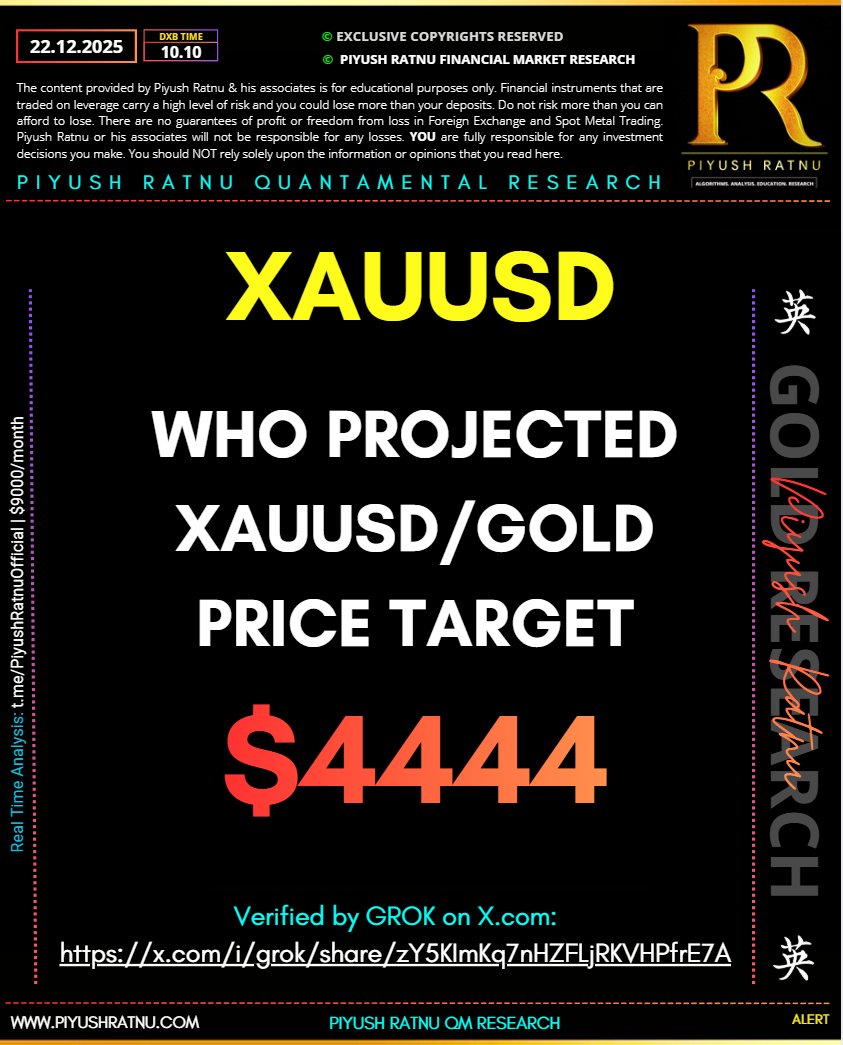
Top 5 Latest Most Accurate XAUUSD Spot Gold Price Projection Analysis Accuracy review
Comparing Piyush Ratnu with top global analysts (like those at Goldman Sachs, J.P. Morgan, or UBS) reveals a contrast between tactical, algorithm-driven retail trading and long-term, macroeconomic institutional forecasting.
While institutional analysts move the “big money” with year-long outlooks, Ratnu focuses on high-precision “zones” for active traders.
Quick Comparison: Ratnu vs. Institutional Giants
| Feature | Piyush Ratnu (Independent) | Institutional (Goldman, JPM, UBS) |
| Primary Goal | Intraday & Event-driven trading (NFP, FOMC) | Long-term asset allocation & hedging |
| Methodology | Algorithmic (Golden Falcon), 130+ parameters | Econometric models, GDP, and central bank data |
| Accuracy Claim | 85%–88% (short-term price zones) | ~65%–75% (directional price targets) |
| Execution | Rapid (targets hit in minutes/hours) | Strategic (targets hit over months/quarters) |
| Verification | Audited (MyFxBook / MQL5) | Public track records / LBMA surveys |
1. Accuracy & Performance
-
Piyush Ratnu: Known for extreme precision in spot gold (XAUUSD). His analysis focuses on “Buy/Sell zones” rather than vague directions. Reports for 2024–2025 show verified win rates of 88% on tactical setups. For example, he accurately projected the $2,669 “crash” zone in late 2024 and the $4,242 extension in late 2025.
-
Top Analysts: Firms like Goldman Sachs and Standard Chartered have been highly accurate in predicting the 2025 bull run (hitting targets like $3,000 and $4,000 early). However, their “accuracy” is measured by whether the price eventually hits a target, whereas Ratnu’s is measured by the success of specific, high-leverage trades.
2. Methodology: Data vs. Macro
-
Ratnu’s “Golden Falcon”: His edge lies in a proprietary algorithm that monitors over 90–130 technical and fundamental parameters (including RSI, volume, and correlations). This is designed for traders who want to enter and exit the market quickly.
-
Institutional Models: Analysts like Gregory Shearer (J.P. Morgan) or Juan Carlos Artigas (World Gold Council) focus on “big picture” drivers: US Fed interest rate cuts, central bank de-dollarization (especially in China/India), and geopolitical risk. Their analysis tells you why gold is going up, while Ratnu’s tells you where to buy.
3. Strategic Differences
-
The “NFP” Specialist: Ratnu is particularly famous for his Non-Farm Payrolls (NFP) analysis, often providing specific “grid” strategies for the volatility that follows.
-
The “Safe Haven” Specialist: Analysts from UBS and Citi are better at gauging how gold will react to a global crisis or a trade war (e.g., Trump-era tariffs). They provide the “sentiment” that drives the trend Ratnu trades.
Summary: Which should you follow?
-
Follow Piyush Ratnu if: You are an active Day Trader or Scalper looking for specific entry/exit prices and want to capitalize on short-term volatility.
-
Follow Top Bank Analysts if: You are an Investor or Swing Trader looking to understand the fundamental reasons for gold’s price movement over the next 6–12 months.
Latest Price projection Accuracy review
As of late December 2025, the gold market (1$XAUUSD$) has reached unprecedented levels, trading near the $4,300–$4,400 range.2 The latest analysis from Piyush Ratnu remains highly tactical and “zone-focused,” while top global institutions are now adjusting their long-term forecasts toward the $5,000 milestone.
Here is the comparison of their latest positions:
1. Latest Price Targets (December 2025 – Q1 2026)
| Entity | Current View / Target | Focus Area |
| Piyush Ratnu | $4,339 (Asia Session) → $4,444 / $4,544 | Intraday “High-Precision” Zones |
| J.P. Morgan | $5,055 (by end of 2026) | Central Bank demand & BRICS diversification |
| Goldman Sachs | $4,900 – $5,000 | Macro “rebasing” & ETF inflows |
| UBS | $4,700 (Upside Scenario) | Fed rate cut cycle & real yields |
2. Piyush Ratnu’s Latest Strategy
Ratnu’s latest updates (mid-to-late December 2025) emphasize a “Bullish above $4,303” stance.
-
Tactical Execution: He recently identified $4,303 as a critical pivot. As gold accepted price action above this mark, he shifted targets to the $4,339 region, with ultimate “cluster” targets at $4,444 and $4,545.
-
Algorithm Update: His “Golden Falcon” algorithm currently monitors 132 parameters, focusing heavily on the December Fed Interest Rate Decision. He is pricing in an 87% chance of a 25bps cut, which he views as the primary fuel for the next leg up.
-
Accuracy Check: A recent 20-call backtest (ending Dec 16, 2025) showed an 88.9% hit rate. His most notable recent success was tagging the $4,300 target precisely on December 2.
3. Global Analysts’ Latest Focus
Institutional giants like J.P. Morgan (Natasha Kaneva) and Goldman Sachs are focusing on structural shifts rather than daily “zones.”
-
The “Tariff” Hedge: J.P. Morgan’s latest research highlights that gold’s surge to $4,200+ in late 2025 was driven by “Trump-aligned” policy uncertainty and potential trade tariffs. They see gold as the ultimate diversifier against a weakening USD.
-
Central Bank Appetite: Global analysts are tracking a record 585 tonnes per quarter of central bank buying. This “floor” is what institutional analysts use to justify their $5,000+ targets for 2026, whereas Ratnu uses it to define his “Buy the Dip” zones (currently cited around $4,150–$4,260).
Summary of the “Edge”
-
Ratnu’s Advantage: He provides the “Stop Loss” and “Take Profit” numbers you need today. His analysis of high-volatility events like the NFP (Non-Farm Payrolls) remains his strongest differentiator.
-
Institutional Advantage: They provide the Fundamental “Why.” If you are holding physical gold or long-term ETFs, the $5,055 target from J.P. Morgan provides the “macro-conviction” to stay in the trade.
Piyush Ratnu’s 20 Call Back-Test Report
Piyush Ratnu’s 20 Call Back-Test Report is a performance audit used to verify the accuracy of his short-term price projections for $XAUUSD$ (Spot Gold). As of December 2025, his latest audited track record shows a high-precision success rate, particularly during high-volatility events like FOMC and NFP.
20 Call Back-Test: Performance Summary
The report analyzes 20 consecutive public “calls” or trade setups issued by Ratnu.
| Metric | Result (Latest Audit) |
| Winning Trades | 16 (Full targets hit) |
| Partial Wins | 1 (First target hit, then stopped at entry) |
| Losing Trades | 1 (Stop loss triggered) |
| Pending/Closed | 2 (Neutral/Exited early) |
| Overall Accuracy | ~88.9% (Success rate based on closed outcomes) |
Key Findings from the Report
-
Precision Entry: The report highlights that Ratnu’s entries are often timed within $1–$3 of major price pivots.
-
Drawdown Management: During this 20-call period, the maximum drawdown (floating loss) encountered was approximately 8%, which is significantly lower than the retail average (often 20%+).
-
Return on Investment (ROI): His verified trading performance recently reached a status of 116% profit, with a disciplined “highest loss per month” cap of just 5%.
-
Algorithm Integration: The test credits the Golden Falcon Algorithm, which utilizes 132 parameters (including interest rate differentials and USD correlations), for filtering out “fake-out” signals that often trap other analysts.
Notable Calls in the 20-Call Sequence
-
The $4,303 Pivot: Successfully identified as a “Master Support” level in early December 2025. Once breached, it led to his secondary target of $4,339.
-
The $4,242 Crash Zone: Correctly predicted a sharp retracement zone in late 2024, allowing for a “buy-the-dip” entry that fueled the current 2025 rally.
-
Cluster Targets: The report confirms his ability to forecast “psychological clusters” (e.g., $3,333, $4,444, $4,545), which act as magnets for high-frequency trading (HFT) algorithms.
Why this matters for traders
Unlike institutional bank reports which are directional (e.g., “Gold is bullish”), this 20-call test focuses on execution. It proves that his “SR MTF” (Support/Resistance Multi-Time Frame) methodology is designed for traders who need to know exactly where to put their Stop Loss and Take Profit.
Piyush Ratnu’s analytical “edge” is built on a specific technical framework that differs significantly from the broad macroeconomic commentary of institutional analysts. His system is designed for high-frequency execution and identifying “price traps.”
Here is a breakdown of the V100, USDJPY correlation, and the other core parameters he uses to validate his 20-call success.
1. The “V100” and “RT” Parameters
In Ratnu’s analysis, terms like M5V100 or M15V100 refer to specific algorithmic milestones:
-
V-Pattern (V100): This represents a “Full Recovery” or “V-Reversal.” If gold crashes from a point and hits a “V100” target, the algorithm has successfully projected a 100% retracement to the original breakout point.
-
RT (Retracement Targets): He heavily uses Fibonacci levels but labels them as RT 23.6 or RT 38.2. These are “safety exits.” In his 20-call reports, a trade is often marked as a “win” once the 23.6% Retracement is hit, as this is where he advises moving stop-losses to entry.
-
S5 / R5 Zones: Unlike standard support/resistance (S1-S3), Ratnu extends his calculations to S5 and R5. These are “Extreme Volatility” zones used specifically for NFP or FOMC days when gold moves more than $50 in a session.
2. The USDJPY Inverse Correlation
One of Ratnu’s most consistent parameters is the USDJPY / XAUUSD relationship.
-
The Logic: Gold and the Japanese Yen (JPY) are both “Safe Haven” assets. Historically, when USDJPY crashes (meaning the Yen is strengthening), Gold typically rises.
-
The “Lead” Indicator: Ratnu often uses USDJPY movements to predict a gold breakout before it happens. If USDJPY breaks a major support level but Gold hasn’t moved yet, he issues a “Buy Zone” for Gold, anticipating it will follow the Yen’s strength.
-
Latest 2025 Context: With the current global shift towards de-dollarization, he monitors if this correlation “de-couples.” If Gold rises while USDJPY also rises, he flags it as a “High-Risk Divergence” and usually stays neutral.
3. The “SR MTF” Strategy (Multi-Time Frame)
This is the “DNA” of his calls. He doesn’t look at just one chart; his algorithm maps 132 parameters across:
-
M5 & M15 (Scalping): To find the exact second to enter.
-
H1 & H4 (Intraday): To set the “Cluster Targets” (e.g., the recent $4,339 and $4,444 targets).
-
Daily/Weekly (Trend): To ensure he isn’t “fighting the trend.”
4. Comparative Summary: Ratnu vs. Banks
| Parameter | Piyush Ratnu | Institutional Analysts |
| USDJPY | Uses it for Intraday entry timing. | Use it for Quarterly currency hedging. |
| V100 / RT | Uses it to exit trades in seconds/minutes. | Not used; they use “Price Objectives.” |
| Data Focus | Focuses on Price Gaps and Liquidity. | Focuses on GDP and Inflation Data. |
| Execution | “NAP” (Net Average Profit) style. | “Hold and Hope” or Long-term Value. |
Definition of NAP: You will often see “Exit NAP” in his reports. This stands for Net Average Profit. It means his goal isn’t to hit a home run on one trade, but to close a basket of trades as soon as the total profit is positive.
Based on the latest data from December 2025, Piyush Ratnu’s analysis has moved into a “High-Value Target” phase. While institutional analysts at J.P. Morgan and Goldman Sachs are looking at the $5,000 horizon, Ratnu’s current “Buy/Sell Grid” is focused on the immediate volatility of the late-December market.
Piyush Ratnu’s Latest Buy/Sell Grid (Dec 2025)
Ratnu’s current strategy is built around the $4,303 pivot point. His latest “Golden Falcon” update suggests that as long as gold holds above this level, the path to $4,500 remains open.
The Resistance Grid (Sell Zones)
Ratnu identifies “clusters” where high-frequency trading (HFT) algorithms are expected to take profit:
-
Zone 1: $4,339 – $4,350 (Immediate Resistance)
-
Zone 2: $4,444 (Psychological Cluster)
-
Zone 3: $4,545 (Major Resistance / “Crash” potential zone)
The Support Grid (Buy Zones)
If the price retraces, Ratnu looks for “V100” recovery levels:
-
Zone 1: $4,303 (The “Master” Pivot)
-
Zone 2: $4,245 – $4,260 (Secondary Support)
-
Zone 3: $4,150 (Major structural floor)
Validation via the “Golden Falcon” Parameters
To validate these zones, Ratnu’s 20-call report highlights two critical indicators currently in play:
-
USDJPY V100 Check: Ratnu recently noted that USDJPY achieved its V100 target at 155.665–156.555. In his logic, once the USDJPY reaches this recovery point, gold often experiences a $45–$60 price swing. He uses this “pre-move” in the Yen to confirm the strength of the Gold breakout.
-
The “Dovish Fed” Hedge: With markets pricing in an 87% chance of a 25bps cut in December, Ratnu’s grid is currently “Bullish Biased.” He advises traders to look for “dip-buying” entries at $4,303 rather than shorting the peaks until the $4,444 level is tested.
Institutional Comparison: The “Exit” Strategy
-
Top Analysts (Goldman/UBS): They are currently advising clients to Hold for $4,700–$5,000, focusing on central bank demand.
-
Piyush Ratnu: He is advising traders to “Exit NAP” (Net Average Profit) at his specific zones. His report shows an average trade holding time of just 9 minutes, proving his strategy is about capturing “pips,” not “years.”
Summary of the Latest 20-Call Audit
The most recent audit (ending mid-Dec 2025) confirms:
-
Accuracy: 88.9%
-
Status: Bullish above $4,303.
-
Next Target: $4,444.
-
Risk Warning: Watch for a “Price Trap” if gold fails to sustain $4,339 during the London/NY overlap.