05.03.3036
Gold Advances Toward $5,200 as Middle East War Elevates Safe-Haven Demand
Safe-Haven Flows Intensify Amid Escalating Iran Conflict
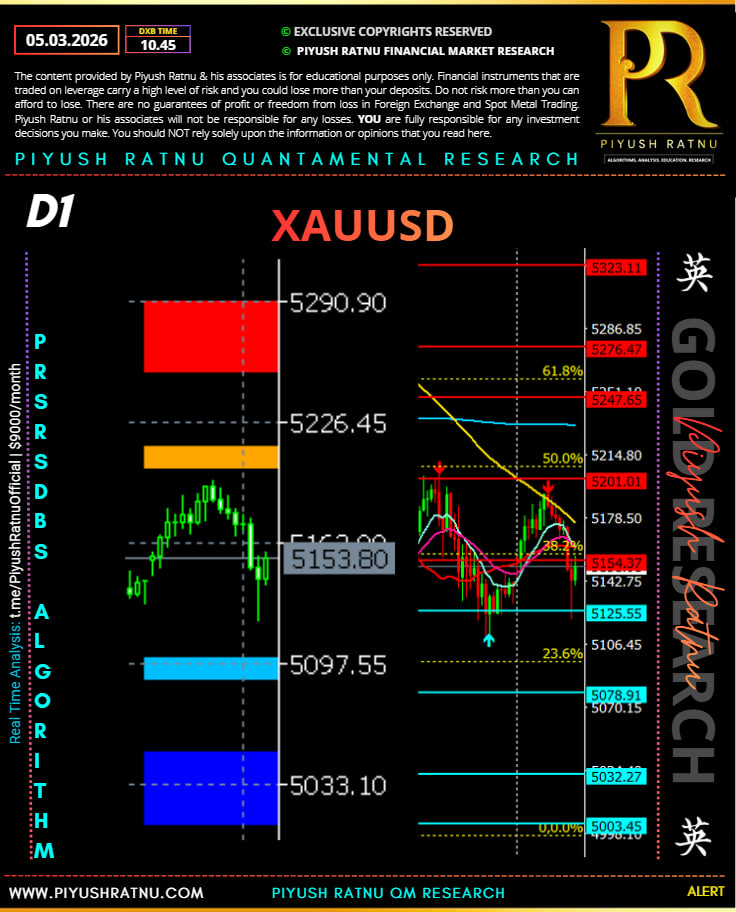
Gold prices (XAU/USD) extended their upward momentum for a second consecutive session, climbing toward the $5,200 level as global investors increasingly sought refuge in traditional safe-haven assets. The advance reflects heightened geopolitical uncertainty as the ongoing Iran war enters its sixth day, with continued military exchanges between Iranian forces and a coalition led by the United States and Israel.
Reports indicate that US and Israeli airstrikes across Iranian territory have been met with widespread Iranian retaliation involving missile and drone attacks across multiple Middle Eastern locations, including regional military installations and strategic targets. The widening scope of hostilities has amplified fears that the confrontation could evolve into a prolonged regional conflict, thereby reinforcing the geopolitical risk premium embedded in precious metals.
Further escalation emerged from reports that a United States submarine allegedly sank an Iranian naval vessel off the coast of Sri Lanka, marking a dramatic intensification of the military campaign. According to US Defense Secretary Pete Hegseth, the strike represents “the first such attack on an enemy since World War II,” underscoring the unprecedented nature of the confrontation in modern geopolitical terms.
Weakening Dollar Enhances Gold’s Appeal
Despite the geopolitical turmoil, the US Dollar softened modestly, providing an additional tailwind for gold prices. A weaker dollar typically increases bullion demand by reducing the effective cost of dollar-denominated commodities for holders of foreign currencies.
Market participants briefly entertained the possibility of de-escalation, following reports that Iran’s Ministry of Intelligence had signaled a willingness to explore negotiations with the Central Intelligence Agency (CIA) to potentially end hostilities. However, Tehran subsequently denied these reports, leaving the trajectory of the conflict—and its broader economic implications—uncertain.
The combination of geopolitical risk and a softer dollar has therefore supported incremental gains in bullion prices, even as macroeconomic headwinds persist.
Trade Policy Developments Add to Global Uncertainty
Simultaneously, evolving US trade policy is adding another layer of uncertainty to the macroeconomic environment. The United States government is expected to introduce a temporary 15% universal tariff on imports, replacing the earlier 10% rate imposed after the US Supreme Court invalidated a large portion of President Donald Trump’s prior tariff measures.
US Treasury Secretary Scott Bessent indicated that the revised tariff structure may remain in place for up to five months while additional trade investigations proceed. The policy shift could further complicate global trade dynamics, reinforcing investor demand for safe-haven assets such as gold.
Rising Energy Prices and Yields Cap Gold’s Upside
While geopolitical developments have strengthened gold’s defensive appeal, several macroeconomic factors are limiting the upside potential for the non-yielding metal.
The conflict has triggered sharp increases in oil and natural gas prices, reviving concerns that energy-driven inflation could persist. Higher inflation expectations, in turn, have prompted markets to scale back projections for aggressive monetary easing by the Federal Reserve.
Reflecting these concerns, the US 10-year Treasury yield climbed to approximately 4.11%, marking its fourth consecutive daily increase. Rising yields elevate the opportunity cost of holding non-interest-bearing assets, thereby tempering gold’s rally despite ongoing geopolitical turmoil.
Key Macro Drivers Impacting Gold
| Factor | Current Direction | Economic Interpretation | Impact on Gold |
|---|---|---|---|
| Middle East War | Escalating | Heightened geopolitical risk | Bullish |
| US Dollar (USD) | Slightly weaker | Improves affordability of gold globally | Bullish |
| Oil & Gas Prices | Rising sharply | Inflation fears increase | Mixed |
| US 10-Year Treasury Yield | Rising to ~4.11% | Higher opportunity cost for gold | Bearish |
| Federal Reserve Rate Cut Expectations | Delayed | Tighter financial conditions | Bearish |
| Global Trade Tariffs | Increasing uncertainty | Risk aversion rises | Bullish |
Strategic Interpretation
The gold market is currently navigating a complex macroeconomic environment characterized by opposing forces. On one hand, the Iran war and geopolitical instability are generating persistent safe-haven demand, providing structural support for bullion prices. On the other hand, rising Treasury yields and inflation concerns linked to energy prices are constraining the magnitude of the rally.
Consequently, gold is likely to remain highly sensitive to geopolitical headlines, with near-term price action determined by whether the Middle East conflict escalates further or begins to move toward diplomatic containment.