
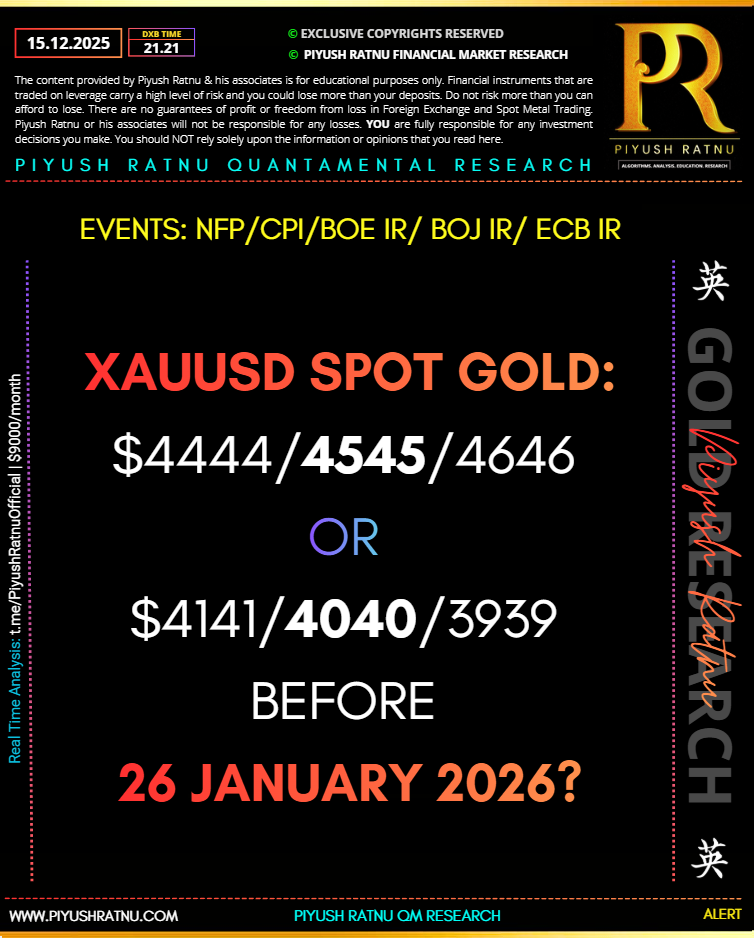
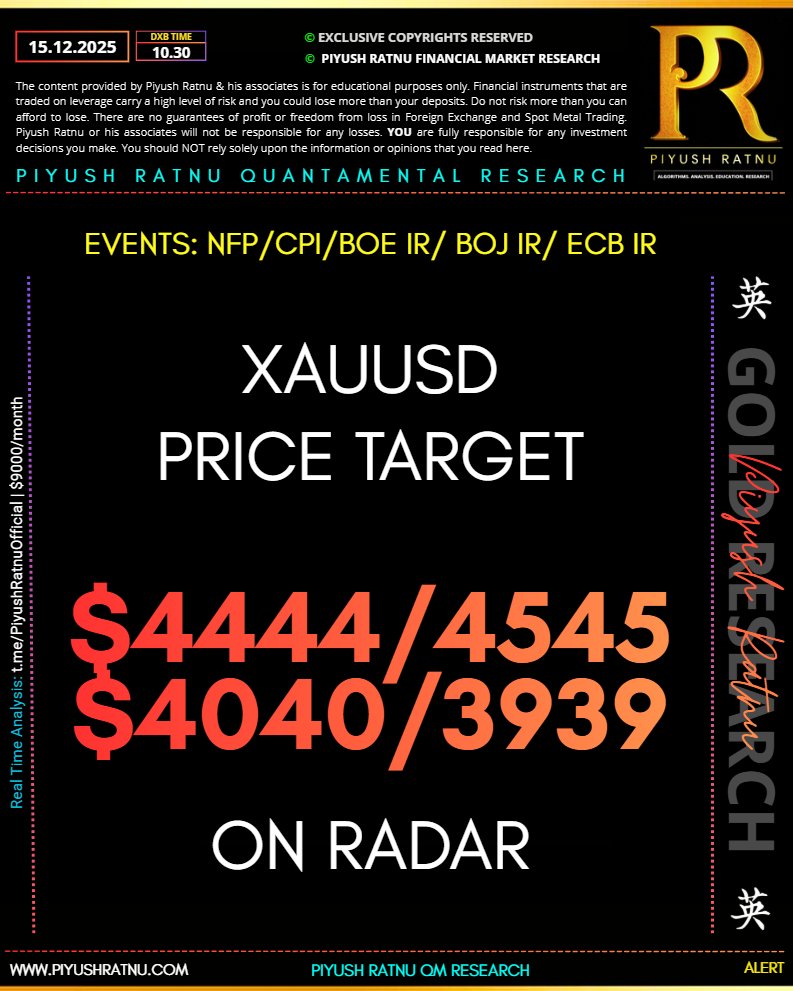
Who projected $4444 XAUUSD Spot Gold Target before 26 January 2026?
Answer: Piyush Ratnu Gold Market Research
PROOF:
1. I had projected $4444 Price Target for XAUUSD Spot Gold on 15 December 2025 on X.com. Instagram and my analysis published on Telegram and Website.
A) Analysis published on website: CLICK HERE
B) X.com: CLICK HERE
C) Instagram: CLICK HERE
D) Telegram: CLICK HERE
E) Verified by GROK AI: CLICK HERE
How to trade XAUUSD Safely in January 2026?
Read detailed analysis at:
https://bit.ly/TRADExauusd2026

Gold Market Update: Macro, Policy, and Structural Drivers
Price Action Overview
Gold (XAU/USD) opened the week with strong upside momentum, reaching a new all-time high near the $4,400/oz level during the Asian session. The rally occurred amid thin year-end liquidity, which amplified the breakout as short-term stops above the $4,345–$4,350 resistance zone were triggered. The broader trend remains firmly constructive, supported by both cyclical and structural tailwinds.
Geopolitical Risk Premium: A Persistent Bid
Middle East, Eastern Europe, and the Americas
Geopolitical risks continue to underpin safe-haven demand:
-
Middle East: Israel has signaled concern over Iran’s potential reconstruction of nuclear enrichment capacity, with renewed military contingency planning under discussion.
-
Eastern Europe: The Russia-Ukraine conflict shows little progress toward resolution, with Russian officials indicating that recent revisions to U.S.-backed proposals have not improved peace prospects.
-
Western Hemisphere: U.S. enforcement actions against Venezuelan oil exports, including tanker interdictions, have increased regional tension and supply-chain uncertainty.
Macro Correlation:
Historically, sustained geopolitical stress increases demand for non-sovereign stores of value, particularly gold, as investors seek protection from tail-risk events that are difficult to hedge through traditional financial instruments.
Monetary Policy Expectations: Fed Dovishness as a Core Catalyst
U.S. Data and Rate Outlook
Recent U.S. macroeconomic releases have reinforced expectations of a gradual but persistent easing cycle:
-
Labor Market: Mixed Nonfarm Payrolls data suggest a cooling employment environment.
-
Inflation: Softer consumer price readings confirm disinflationary momentum.
-
Rates: Futures markets now price additional Fed rate cuts into 2026, extending the outlook for lower real yields.
Gold–Rates Correlation:
Gold exhibits a strong inverse relationship with real interest rates. As expected policy rates decline and inflation remains contained, the opportunity cost of holding non-yielding assets falls, structurally supporting higher gold prices.
U.S. Dollar Dynamics: Fading Support
The U.S. Dollar Index has struggled to extend its recent rebound from multi-month lows. Dovish rate expectations and growing concerns over fiscal sustainability have limited USD upside, reinforcing gold’s strength in dollar terms.
Correlation Insight:
A softer USD mechanically boosts XAU/USD and reflects broader investor diversification away from dollar-centric assets amid shifting global reserve preferences.
Market Structure and Liquidity Considerations
Stop-Driven Acceleration
The latest upside extension was amplified by:
-
Stop-loss activation above key resistance levels
-
Reduced liquidity due to year-end trading conditions
-
Momentum-based systematic flows re-engaging on breakout confirmation
This suggests price velocity rather than speculative excess, with positioning still supported by fundamentals.
Structural Shifts in the Global Gold Market
Asia’s Rising Role in Physical Metals
Recent developments point to a rebalancing between paper and physical gold markets:
-
JP Morgan relocated its gold trading desk from New York to Singapore, signaling a strategic pivot toward Asia’s physical bullion ecosystem.
-
COMEX experienced an extended trading halt during a period of heavy physical delivery, raising questions around paper-market resilience under stress.
-
Singapore’s role continues to expand due to tariff-free gold imports, proximity to Asian demand centers, and integration with the Shanghai Gold Exchange.
Structural Interpretation:
This does not imply imminent failure of Western futures markets, but it does highlight:
-
Growing demand for physical settlement
-
A shift in liquidity toward Asia-based bullion hubs
-
Reduced tolerance for counterparty and custodial risk
Central Banks and De-Dollarization Trends
-
Central banks continue to accumulate and repatriate gold at record levels, reducing reliance on foreign custodians.
-
BRICS economies have accelerated U.S. Treasury sales, reflecting long-term diversification away from dollar-denominated reserves.
Macro Correlation:
Gold benefits directly from reserve diversification trends, functioning as a politically neutral asset amid fragmentation of the global monetary system.
Precious Metals Complex: Spillover Effects
Physical demand for silver has also surged, particularly in Asia, reinforcing the narrative of broad-based hard-asset accumulation rather than isolated gold speculation. This supports the view that the current move reflects capital preservation behavior, not short-term risk-on sentiment.
Forward-Looking Risks and Catalysts
Near-Term
-
U.S. GDP and Durable Goods data
-
FOMC member speeches
-
Ongoing geopolitical headlines
Medium-Term
-
Evolution of Fed policy expectations
-
Stability of USD funding markets
-
Continued central bank reserve policy shifts
Conclusion
Gold’s advance toward the $4,400 region is macro-driven, not anomalous. The convergence of:
-
Persistent geopolitical risk
-
Declining real rates
-
Structural shifts toward physical markets
-
Central bank demand and de-dollarization
creates a supportive long-term framework. Near-term pullbacks may occur due to positioning or liquidity effects, but the broader risk-reward profile remains skewed to the upside under current macro conditions.
Gold (XAU/USD): Quantitative Correlations & Technical Outlook
1. Quantitative Macro Correlations (Historical Context)
Gold vs Real Yields (10Y TIPS)
-
Correlation: –0.65 to –0.75 (rolling 3–5Y)
-
Interpretation:
This is gold’s dominant driver. Every sustained 100 bp decline in real yields has historically been associated with a 15–25% upside move in gold, depending on volatility regime. -
Current Regime:
Real yields are compressing as rate-cut expectations extend into 2026 → structurally bullish.
Gold vs U.S. Dollar Index (DXY)
-
Correlation: –0.55 to –0.65
-
Interpretation:
Gold acts as a counter-USD asset. Periods of dollar weakness driven by monetary easing or reserve diversification amplify gold rallies. -
Current Regime:
USD rebound attempts lack rate support → gold remains bid on dips.
Gold vs Equity Volatility (VIX)
-
Correlation: +0.35 to +0.45
-
Interpretation:
Gold benefits from risk asymmetry, not outright panic. Sustained geopolitical uncertainty keeps volatility elevated enough to support flows without forcing liquidation. -
Current Regime:
Elevated geopolitical risk premium → consistent safe-haven allocation.
Gold vs Fed Funds Expectations (2Y UST / OIS)
-
Correlation: –0.60
-
Interpretation:
Gold responds more to policy expectations than realized cuts. When markets price prolonged easing, gold tends to front-run the cycle. -
Current Regime:
Futures pricing multiple cuts into 2026 → long-duration tailwind.
Gold vs Central Bank Balance Sheet Expansion
-
Correlation: +0.50 (lagged)
-
Interpretation:
Gold benefits with a lag from liquidity expansion and reserve diversification. -
Current Regime:
Record central bank buying + repatriation → structural demand floor.
2. Market Structure & Positioning Insight
-
Speculative positioning: Elevated but not extreme relative to prior cycle peaks.
-
ETF flows: Stabilizing after earlier profit-taking, consistent with institutional re-entry.
-
Physical demand: Strong Asia-led flows reduce downside elasticity.
Conclusion:
This is a macro-led accumulation phase, not a late-cycle blow-off.
3. Technical Analysis: Multi-Timeframe Levels
Long-Term (Weekly)
-
Primary Trend: Strong bullish (higher highs / higher lows)
-
200-DMA: Far below spot → trend firmly intact
-
Macro Support Zone:
$3,950 – $4,050
(Institutional accumulation range; prior breakout base)
Medium-Term (Daily)
Key Levels:
Resistance / Upside Targets
-
$4,400 – $4,444: Psychological + extension target
-
$4,545: Measured move from prior consolidation
-
$4,800 (tail risk): Requires acceleration in geopolitics or sharp real-yield collapse
Support Levels
-
$4,343 – $4,369: Former resistance, now first support
-
$4,285 – $4,300: Liquidity pocket / stop-run origin
-
$4,150: Trend support (daily structure)
Short-Term (Intraday / Tactical)
-
Momentum support: $4,343
-
Below $4,300: Likely triggers mean-reversion buying, not trend reversal
-
Only a sustained break below $4,141 would neutralize bullish bias
4. Scenario Framework
Base Case (High Probability)
-
Gradual Fed easing expectations persist
-
Geopolitical risk remains unresolved
➡ Gold consolidates above $4,343 and grinds higher
Bull Case
-
Real yields fall sharply
-
Escalation in Middle East or USD confidence shock
➡ Acceleration toward $4,545–$4,884
Bear Case (Lower Probability)
-
Sudden USD funding stress
-
Hawkish policy repricing
➡ Correction toward $4,141–$4,040 (buy-the-dip zone)
5. Summary
Gold’s rally is quantitatively justified by:
-
Strong inverse correlation with real yields
-
Persistent USD headwinds
-
Structural central bank demand
-
Shift toward physical settlement and Asian liquidity hubs
From a macro-technical perspective, pullbacks remain corrective, not trend-changing, unless accompanied by a sharp reversal in real-rate expectations.
Intermarket Dashboard: Gold in Macro Context
1. Gold vs Real Yields (10Y TIPS)
Correlation: –0.70
| Signal | Impact |
|---|---|
| Real yields ↓ | Gold ↑ (high conviction) |
| Real yields ↑ >30bp | Gold consolidates / corrects |
| Real yields <1% | Gold acceleration phase |
Current State:
Yields compressing → trend supportive
2. Gold vs U.S. Dollar (DXY)
Correlation: –0.60
| DXY Move | Gold Response |
|---|---|
| Gradual USD decline | Gold grind higher |
| Sharp USD spike | Temporary gold pullback |
| USD confidence shock | Explosive gold upside |
Current State:
USD rebound lacks policy support → gold favored
3. Gold vs Equities (S&P 500)
Correlation: ~0 to –0.20 (regime-dependent)
-
Gold can rise with equities when driven by liquidity
-
Gold outperforms equities during geopolitical stress
Current State:
Gold acting as portfolio hedge, not risk-off panic asset
4. Gold vs Oil (WTI/Brent)
Correlation: +0.35
| Oil Signal | Gold Implication |
|---|---|
| Oil ↑ on geopolitics | Inflation hedge → Gold ↑ |
| Oil ↑ on demand | Neutral to mildly positive |
| Oil ↓ on recession fears | Gold supported via rates |
Current State:
Geopolitical bid → positive spillover
5. Gold vs Bitcoin
Correlation: Low (+0.15 long-term)
| Market Stress | Capital Flow |
|---|---|
| Monetary debasement | BTC + Gold |
| Geopolitical risk | Gold > BTC |
| Liquidity tightening | Gold holds better |
Current State:
Gold preferred by institutions & central banks
6. Gold vs Copper (Growth Signal)
Correlation: –0.30
-
Copper weak → growth slowdown → Fed easing → gold positive
-
Copper strong → reflation → neutral for gold unless yields rise
Positioning & Flow Overlay
| Indicator | Signal |
|---|---|
| CFTC positioning | Elevated, not extreme |
| ETF flows | Stabilizing inflows |
| Physical demand | Strong Asia-led |
| Central banks | Persistent net buyers |
➡ Trend durability confirmed
Strategy Summary (Desk View)
Primary Trade:
✔ Buy pullbacks above $4,300
✔ Scale entries, hold core
✔ Use $4,000 as macro invalidation
Avoid:
✘ Chasing breakouts without pullbacks
✘ Overreacting to short-term USD spikes
Key Risk to Thesis:
-
Sharp rise in real yields driven by hawkish Fed repricing
