
Gold Retreats Below $5,300 Amid USD Strength Despite Escalating Middle East Risk
Dollar Appreciation Reasserts Pressure on Bullion
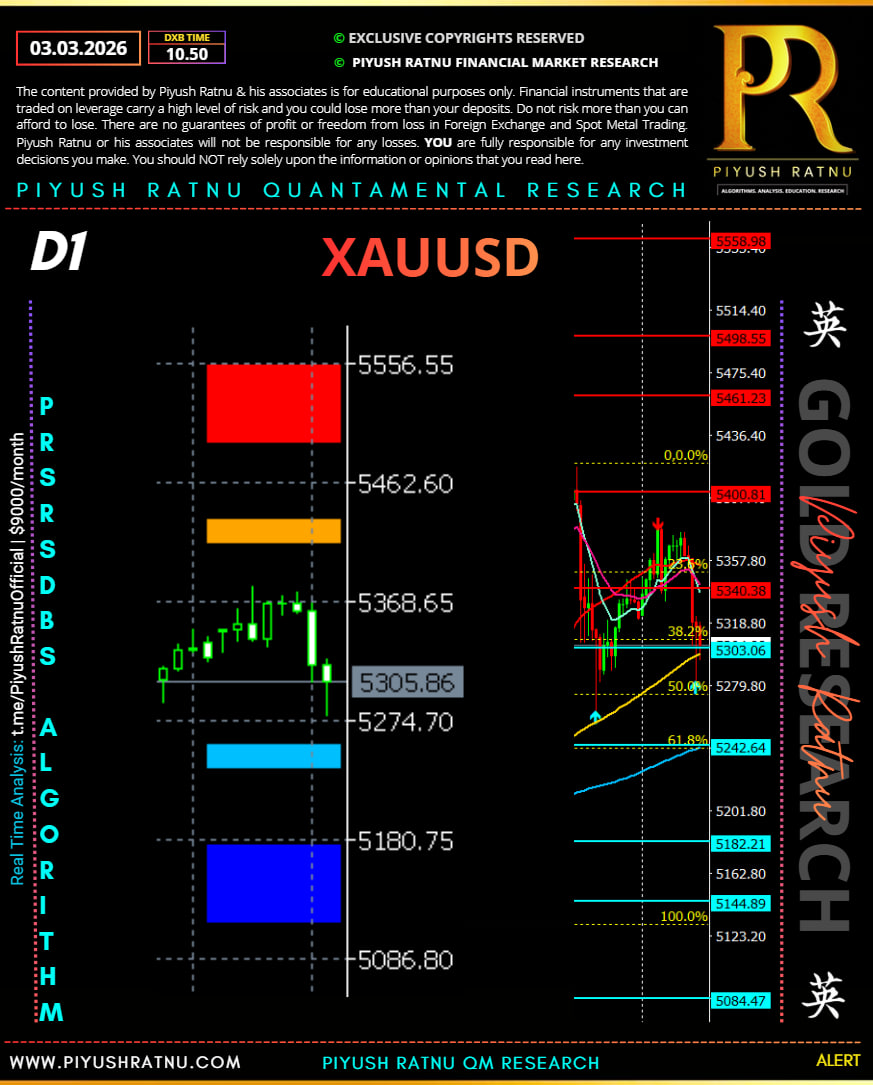
Gold prices encountered renewed selling pressure on Tuesday as the U.S. Dollar strengthened across major currency pairs, forcing XAU/USD to retreat sharply from its intraday peak near $5,380. The precious metal declined by roughly $100, slipping below the $5,300 threshold, as sustained demand for the Greenback overshadowed the traditional safe-haven appeal of bullion.
The U.S. Dollar Index (DXY) extended its upward trajectory to the highest level since January 20, reflecting a broad reallocation of global capital toward dollar-denominated assets. Concurrently, USD/JPY appreciation and a rising U.S. 10-year Treasury yield reinforced the tightening financial conditions backdrop, thereby exerting downward pressure on non-yielding assets such as gold.
The price rejection near $5,400 resistance during the previous trading session has further reinforced a near-term technical ceiling, prompting tactical profit-taking and positioning adjustments among leveraged macro funds.
Geopolitical Risk Premium Remains Elevated
Despite the decline, downside momentum in gold remains structurally constrained by intensifying geopolitical tensions in the Middle East. Escalating hostilities involving Iran have heightened fears of a broader regional conflict capable of disrupting global energy and shipping routes.
Iran’s Islamic Revolutionary Guard Corps (IRGC) Navy reportedly announced a closure of the Strait of Hormuz, the world’s most critical maritime chokepoint for oil transport. Additionally, a drone strike targeting the U.S. Embassy compound in Riyadh has significantly intensified geopolitical risk perceptions.
Meanwhile, U.S. Secretary of State Marco Rubio indicated that Washington anticipates a material escalation in hostilities against Iranian targets within the next 24 hours. The warning follows remarks from President Donald Trump, who signaled that a “major wave” of military developments may be imminent.
The U.S. State Department has also issued an urgent advisory urging American citizens to evacuate several Middle Eastern countries, further reinforcing market perceptions that the geopolitical situation could deteriorate rapidly.
Under such circumstances, gold’s safe-haven bid remains structurally intact, limiting the probability of an aggressive downside repricing despite near-term dollar strength.
Monetary Policy Expectations Continue to Support the Dollar
Another factor weighing on bullion is the recalibration of Federal Reserve policy expectations. Market participants have gradually scaled back expectations for aggressive rate cuts, following resilient U.S. macroeconomic data and persistent inflation concerns.
Higher Treasury yields increase the opportunity cost of holding non-yielding assets, such as gold, encouraging capital rotation into interest-bearing instruments.
In the absence of major U.S. macroeconomic releases during the current session, geopolitical developments surrounding the Iran conflict remain the dominant catalyst for cross-asset volatility.
Cross-Market Drivers Influencing Gold
| Macro Variable | Current Direction | Market Interpretation | Impact on Gold |
|---|---|---|---|
| US Dollar Index (DXY) | Rising | Strong demand for USD liquidity | Bearish |
| US 10-Year Treasury Yield | Rising | Higher real yields increase opportunity cost of gold | Bearish |
| USD/JPY | Rising | Dollar strength vs. yen signals risk repricing | Bearish |
| Middle East Geopolitical Risk | Escalating | War premium increases safe-haven demand | Bullish |
| Fed Rate Cut Expectations | Moderating | Less aggressive easing path | Bearish |
 Strategic Interpretation
The current market configuration reflects a classic macro tug-of-war between dollar liquidity dominance and geopolitical risk premia. While rising U.S. yields and a strengthening dollar create immediate headwinds for bullion, the war-driven safe-haven demand prevents a disorderly downside repricing.
As a result, gold remains trapped in a macro-driven equilibrium zone, where USD strength dictates short-term direction while geopolitical risk defines the structural floor.
XAU/USD – 15-Day Scenario Probability Model (War Shock vs USD Strength)
The current gold market structure is dominated by two opposing macro forces:
-
USD Liquidity Dominance (rising DXY, rising US10Y yields, rising USDJPY)
-
Geopolitical Risk Premium (Iran conflict, Strait of Hormuz closure risk, Middle East escalation)
Historically, when these forces collide, gold tends to trade in volatility clusters rather than trending immediately. The next 15 trading days are therefore best analyzed using scenario-weighted probability zones.
Macro Scenario Framework
| Scenario | Description | Probability | Market Behavior |
|---|---|---|---|
| Controlled Conflict | Limited regional escalation, USD strength dominates | 45% | Gold consolidation or mild decline |
| Escalation Shock | Military escalation / oil shock / shipping disruption | 35% | Sharp safe-haven rally |
| Dollar Liquidity Squeeze | Yields spike + USD rally | 20% | Gold correction phase |
Quantified XAUUSD Price Zones (15-Day Projection)
| Price Zone | Probability | Scenario Trigger | Market Interpretation |
|---|---|---|---|
| $5,420 – $5,520 | 30% | War escalation | Safe haven surge |
| $5,300 – $5,420 | 35% | Base case | Volatility range |
| $5,150 – $5,300 | 25% | USD strength | Tactical correction |
| $4,980 – $5,150 | 10% | Yield spike / risk liquidation | Panic flush |
Expected volatility band:
±4.8% over 15 trading days
Murray Math Key Levels (Institutional Structure)
| Murray Level | Price | Market Meaning | Trading Bias |
|---|---|---|---|
| +2/8 Extreme | $5,600 | War panic extension | Sell exhaustion |
| +1/8 Overbought | $5,480 | Breakout zone | Momentum buy |
| 8/8 Major Resistance | $5,400 | Structural ceiling | Break = bullish |
| 7/8 Weak Resistance | $5,340 | Intraday rejection | Sell scalps |
| 6/8 Pivot Zone | $5,300 | Equilibrium | Neutral |
| 5/8 Major Support | $5,200 | Institutional buy zone | Buy |
| 4/8 Key Support | $5,100 | Trend defense | Strong buy |
| 3/8 Oversold | $4,980 | Panic washout | Accumulation |
Professional Trading Setup
| Setup | Entry | Stop | Target | Probability |
|---|---|---|---|---|
| Range Buy | $5,200–$5,230 | $5,140 | $5,340 | 62% |
| Breakout Buy | Above $5,405 | $5,330 | $5,520 | 58% |
| Momentum Sell | $5,360–$5,400 rejection | $5,450 | $5,250 | 55% |
| Crash Hedge Buy | $5,050–$5,100 | $4,960 | $5,300 | 70% |
Cross-Asset Transmission Model
| Asset | Current Direction | Gold Impact |
|---|---|---|
| DXY | Rising | Bearish |
| US10Y Yield | Rising | Bearish |
| USDJPY | Rising | Bearish |
| Oil (War Risk) | Rising | Bullish |
| Equities (Risk) | Unstable | Bullish |
Quantified Expected Path (Most Likely)
Base case trajectory:
$5,300 → $5,220 → $5,340 → $5,420
This implies high volatility but upward drift if war risk persists.
Key Trigger Events (Next 15 Days)
-
Strait of Hormuz shipping disruption
-
US military strike on Iran
-
Oil > $120 spike
-
US Treasury yield > 4.9%
-
Central bank safe-haven buying
Any of these could rapidly push gold toward $5,500+ panic levels.
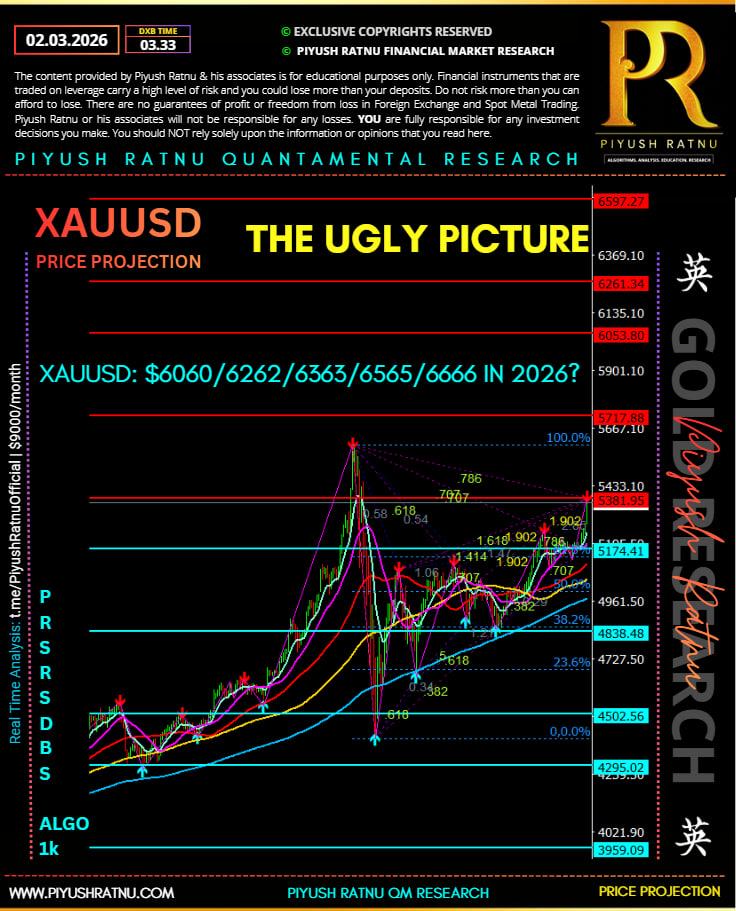 Read in depth analysis: How to trade XAUUSD during US Iran War? Case $6060 | Case $6666