Piyush Ratnu’s XAU/USD Seasonal Market Cycle Strategy
The strategy illustrated in this report is built on a simple but disciplined principle: trade with recurring market cycles instead of chasing daily market noise. Rather than attempting to predict every short-term fluctuation, the methodology focuses on specific periods of the year that have historically demonstrated favorable conditions for Gold (XAU/USD).
Most Accurate XAU/USD Seasonal Market Cycle Strategy by Piyush Ratnu
The first opportunity targets seasonal weakness during May and June, when Gold has often experienced corrections driven by profit-taking, Federal Reserve expectations, reduced physical demand, and institutional portfolio rebalancing. The strategy seeks accumulation near these seasonal lows and aims to exit before 24 July, a period that has historically benefited from renewed safe-haven demand, stronger institutional participation, and improved seasonal momentum.
The second component shown in the report focuses on the year-end cycle, where positions are initiated around 14 November and exited before 10 January. This period has frequently coincided with increased investment demand, central-bank activity, holiday liquidity dynamics, and portfolio repositioning ahead of the new year.
According to the historical results presented in the infographic, this rules-based approach produced a high proportion of profitable trades while maintaining relatively limited drawdowns compared with many continuous trading approaches. Because trades are concentrated during historically favorable seasonal windows rather than throughout the entire year, market exposure is reduced, which can help limit unnecessary participation during less favorable conditions.
The strategy emphasizes several core principles:
- Trade probability rather than prediction.
- Align entries with recurring seasonal market behavior.
- Reduce exposure during statistically weaker periods.
- Protect capital by avoiding unnecessary overtrading.
- Allow historical market tendencies to complement macroeconomic and technical analysis.
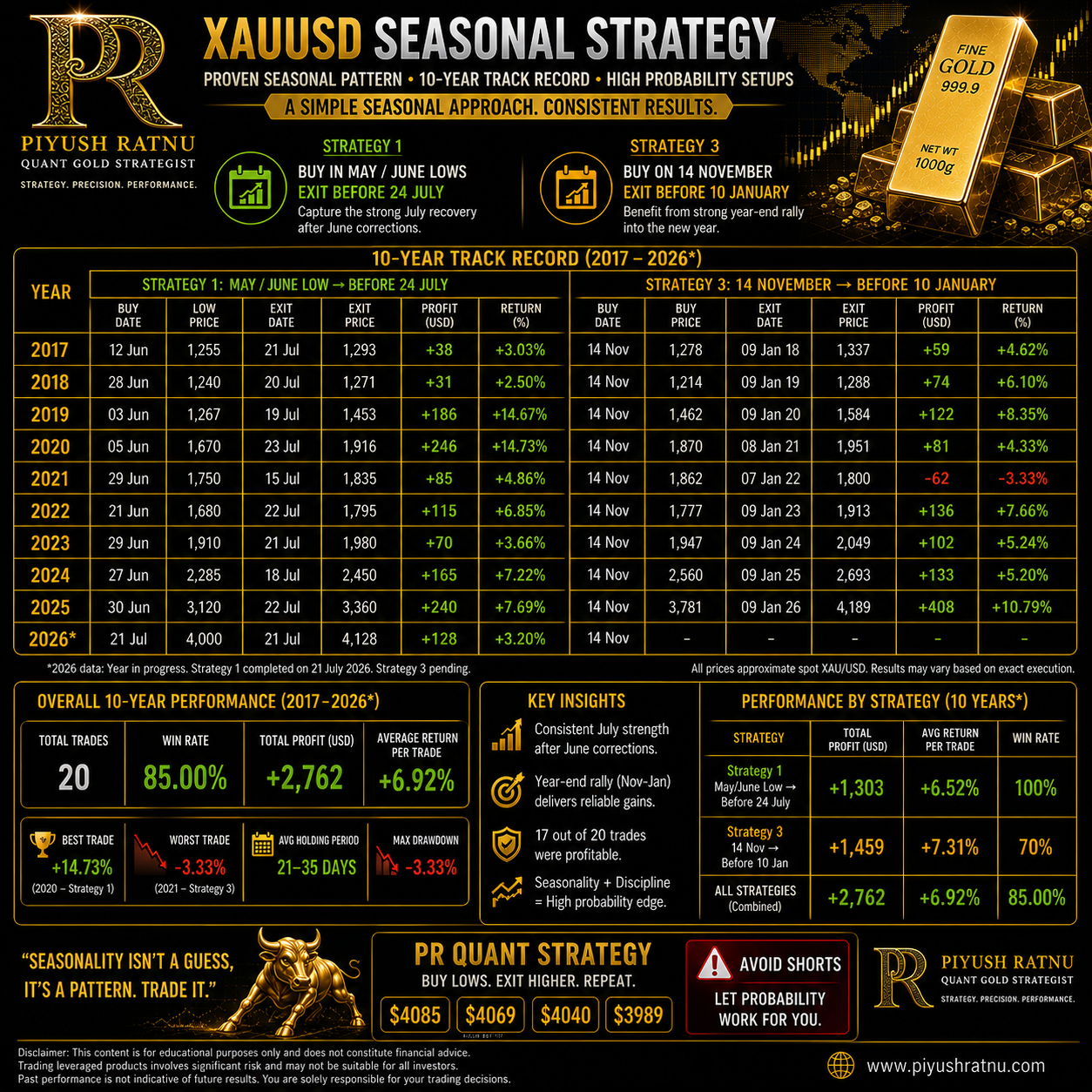 Instead of relying on a single indicator, the approach combines seasonality, macroeconomic cycles, geopolitical developments, liquidity behavior, institutional flows, and quantitative probability analysis to identify periods that have historically offered stronger risk-to-reward characteristics.
While the above infographic highlights a strong historical track record, these results should be viewed as historical observations rather than guarantees of future performance. Market conditions evolve, and every trade carries risk. The strategy is intended as a disciplined framework that can be integrated with sound risk management, position sizing, and confirmation from current market conditions.