Piyush Ratnu – Quant Gold Strategist
Professional Profile
Piyush Ratnu is an independent Quant Gold Strategist specializing in the global Gold (XAU/USD) market. His work is centered on the development of systematic, probability-driven analytical frameworks that combine quantitative research, macroeconomic analysis, institutional liquidity concepts, technical market structure, volatility modeling, and disciplined risk management. His objective is to simplify complex financial markets through structured research that enables traders, investors, and institutions to make informed decisions based on evidence rather than emotion.
Unlike conventional market analysis that often depends on isolated technical indicators or short-term price action, Piyush’s research philosophy is built upon a multi-dimensional analytical process that integrates macroeconomic variables, intermarket relationships, behavioral finance, institutional positioning, and statistical probability. This approach is designed to evaluate market conditions holistically, recognizing that gold prices are influenced by a combination of economic fundamentals, monetary policy, geopolitical developments, investor sentiment, and liquidity dynamics.
Over the years, Piyush has dedicated his research to understanding the behavior of Gold (XAU/USD) during major macroeconomic events such as Federal Reserve meetings (FOMC), Consumer Price Index (CPI) releases, Producer Price Index (PPI) reports, Non-Farm Payrolls (NFP), central bank policy announcements, sovereign bond market movements, geopolitical conflicts, and global risk sentiment. His work seeks to identify recurring patterns in these events and their historical influence on gold prices, enabling the construction of structured probability scenarios rather than directional predictions.
Ranked under top 5 Most Accurate XAUUSD Analysts in World:
Chatgpt Ai | Google – Gemini Ai | BING – CoPilot Ai
 The Golden Falcon Quant Framework
At the core of Piyush Ratnu’s research lies the Golden Falcon Quant Framework, a proprietary research methodology developed to evaluate the gold market through multiple independent layers of analysis. The framework combines macroeconomic research, institutional liquidity mapping, technical structure, volatility assessment, intermarket correlation, behavioral finance, and event-driven analysis into a single integrated decision-making model.
Rather than relying on one indicator or trading signal, the framework evaluates a broad range of variables before reaching a market conclusion. The methodology is designed around the principle that higher-quality market decisions emerge when multiple independent factors align to support a particular scenario.
The framework incorporates several key analytical pillars:
- Global macroeconomic analysis
- Federal Reserve policy evaluation
- Inflation expectations
- Interest-rate trends
- US Dollar Index (DXY)
- US Treasury yields
- USD/JPY correlation
- Crude oil and commodity relationships
- Institutional liquidity mapping
- Technical market structure
- Volatility analysis
- Behavioral finance
- Seasonal market cycle research
- Event-driven probability modeling
- Risk management and capital preservation
This multi-layered process is intended to reduce analytical bias and improve decision quality by requiring confirmation across numerous market dimensions before a research conclusion is published.
Research Methodology
Piyush’s methodology begins with a comprehensive macroeconomic assessment. Economic data, central bank communication, inflation trends, employment reports, and geopolitical developments are analyzed to determine the broader macro environment. This macro perspective is then combined with intermarket analysis involving the US Dollar Index, Treasury yields, USD/JPY, silver, crude oil, and equity market sentiment.
The next stage focuses on institutional liquidity. Historical price behavior is studied to identify areas where institutional participation has previously been concentrated. These liquidity zones are evaluated alongside technical support and resistance structures, order-flow concepts, and volatility conditions to determine areas of elevated market interest.
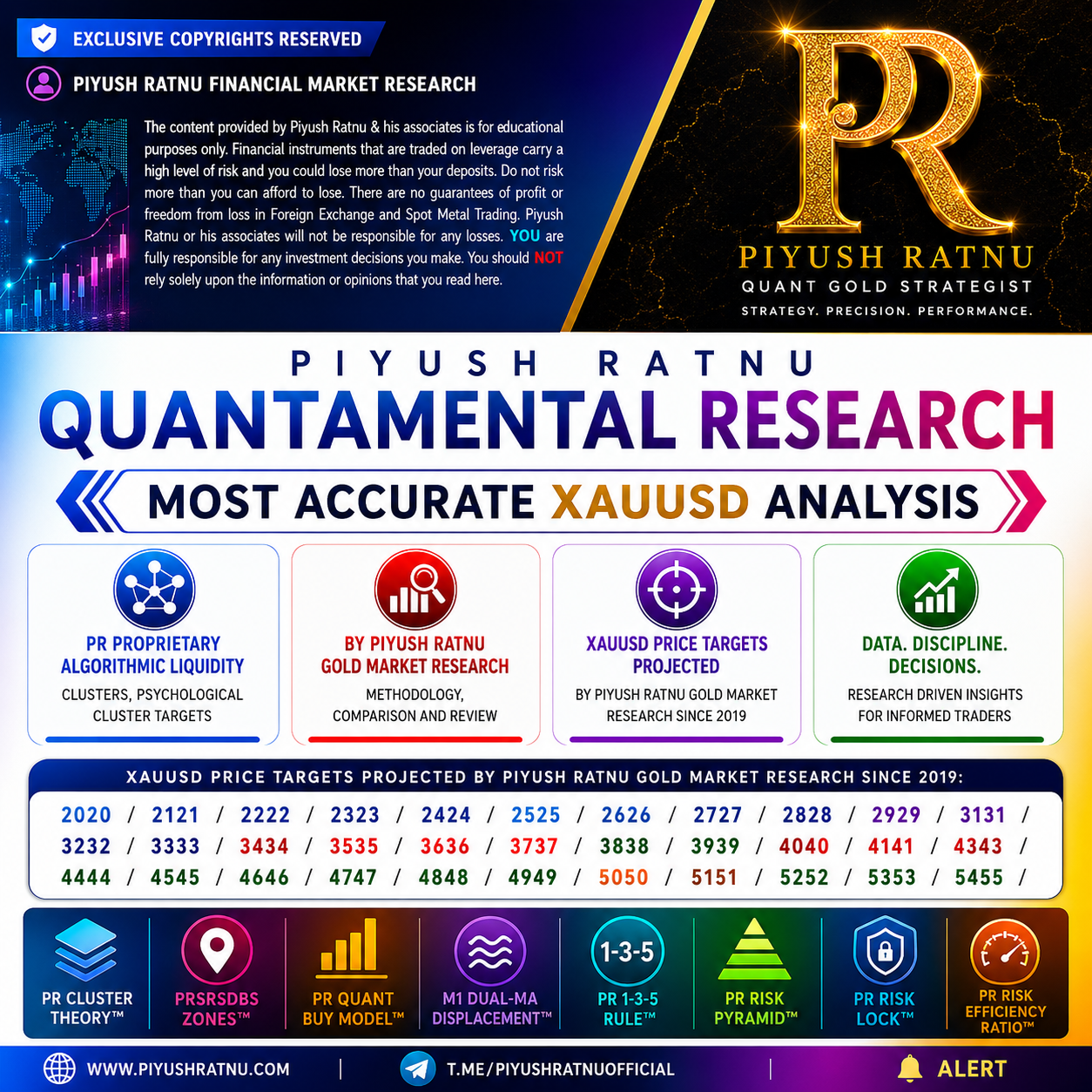
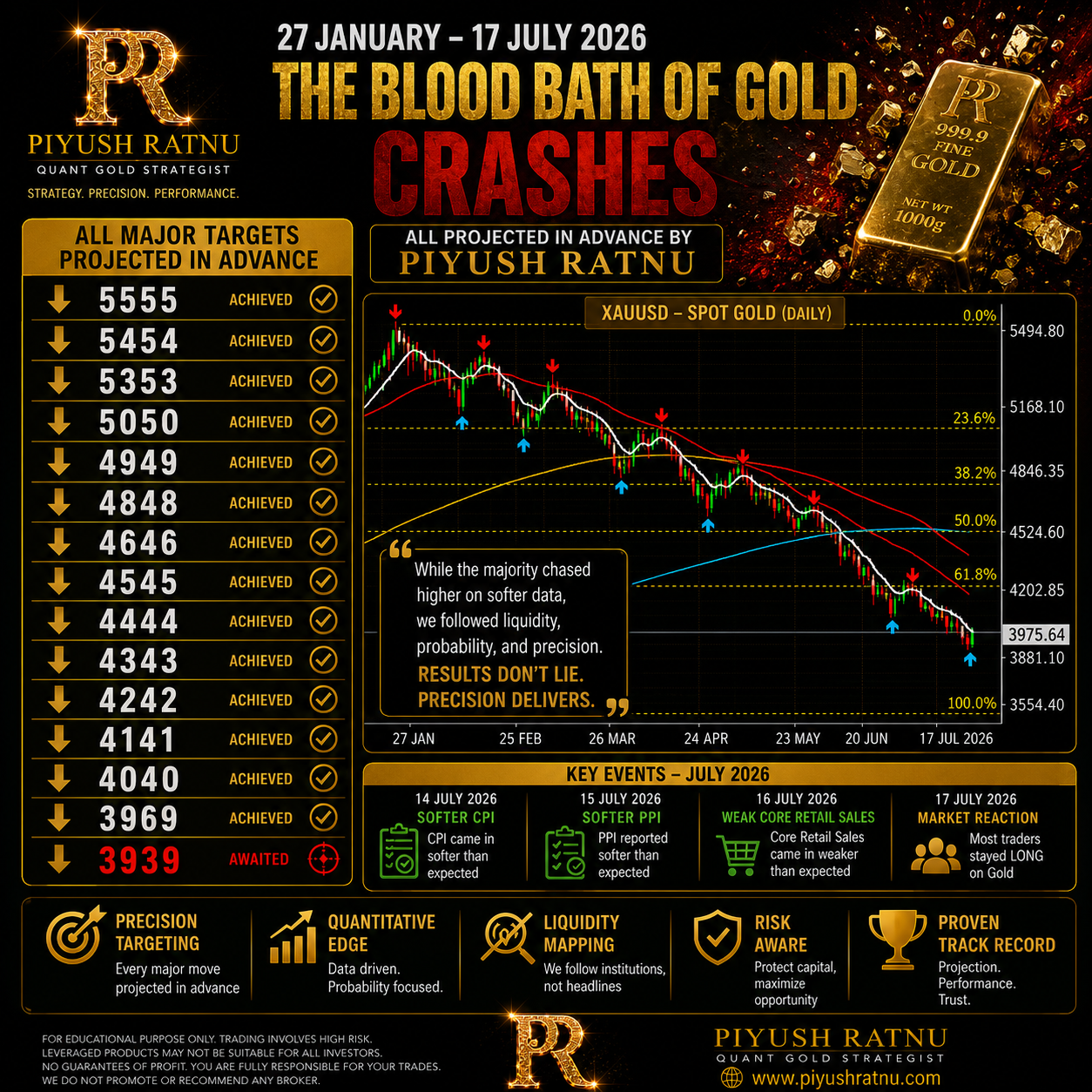
Another defining element of the methodology is the study of psychological price clusters. Through historical market observations, recurring numerical levels have been identified as potential areas where price reactions may occur. Published research frequently references levels such as 3535, 3636, 3939, 3969, 4040, 4069, 4141, 4242, 4343, 4444, 4545, 4646, 4747, 5353, and 5555. These levels are used as analytical reference points within the broader framework and are not intended to imply certainty regarding future market behavior.
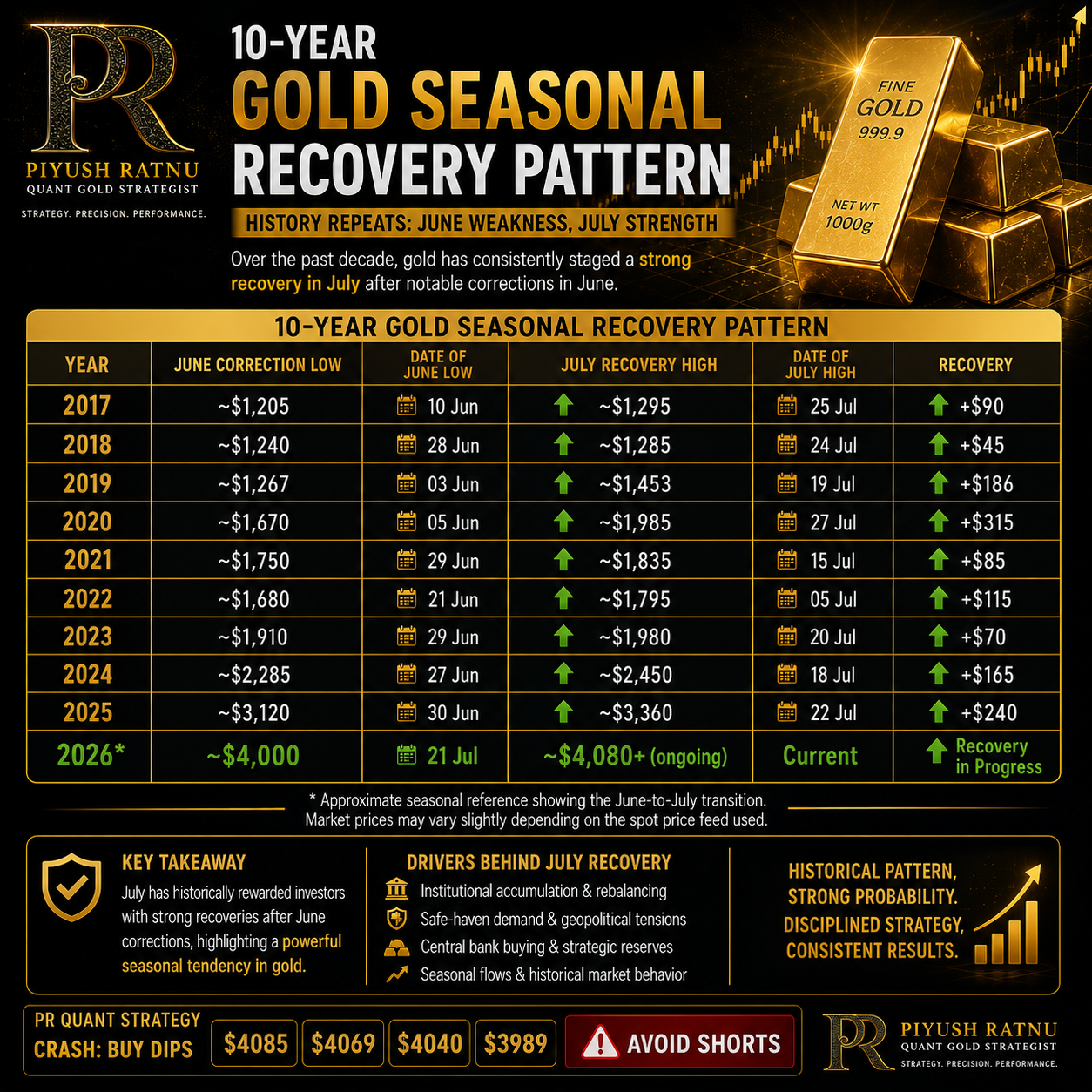
Seasonality also forms part of the research process. Historical monthly tendencies are examined alongside prevailing macroeconomic conditions to determine whether seasonal behavior supports or contradicts the broader analytical outlook. Seasonal analysis is never used in isolation but rather as one component within the overall framework.
 Institutional Market Analysis
A significant component of Piyush’s published research focuses on understanding the relationship between gold and broader financial markets. Gold is evaluated within the context of monetary policy, inflation expectations, sovereign debt markets, currency movements, commodity trends, and geopolitical developments.
Key relationships regularly monitored include:
- Gold and the US Dollar Index (DXY)
- Gold and US Treasury yields
- Gold and USD/JPY
- Gold and crude oil
- Gold and inflation expectations
- Gold and Federal Reserve policy
- Gold and geopolitical risk
- Gold and central bank gold purchases
Monitoring these relationships enables the development of structured market scenarios that consider both technical and macroeconomic influences simultaneously.
Research Publications
Piyush regularly publishes educational market commentary, macroeconomic outlooks, event-driven research reports, and analytical studies focused on Gold (XAU/USD). His publications aim to explain market dynamics through structured reasoning rather than speculation. Major themes include liquidity analysis, volatility assessment, institutional positioning, seasonal behavior, and the interpretation of macroeconomic events.
Historical Research Validation
Continuous evaluation is a central component of the research process. Historical publications are periodically reviewed to assess consistency, identify strengths, and refine the analytical framework. One published historical review summarized 75 research calls and reported the following results:
- Calls Reviewed: 75
- Direct Hits: 64
- Partial Hits: 9
- Missed Calls: 2
- Full Accuracy: 85.33%
- Combined Accuracy (Direct + Partial): 97.33%
- Check: Verified by CHATGPT
These figures are presented as results from a published backtest methodology used to evaluate historical research outputs. They are intended to illustrate the historical performance of the analytical framework and should not be interpreted as independently audited investment performance or a guarantee of future market results.
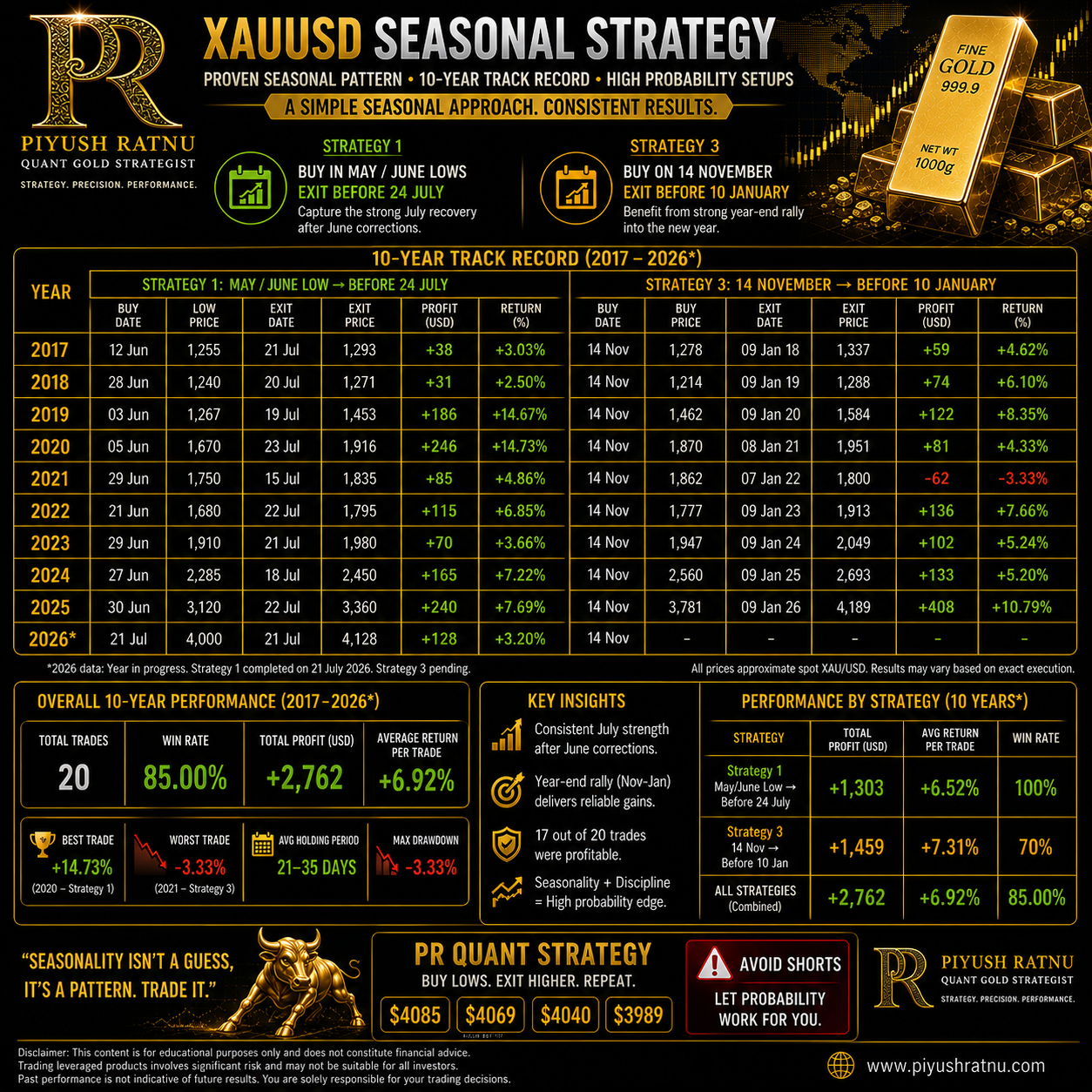
Seasonal Cycles Projection| January-June 2026 Accuracy Report
Risk Management Philosophy
Piyush emphasizes that successful market participation depends as much on risk management as on market analysis. His philosophy places capital preservation ahead of return maximization, advocating disciplined position sizing, predefined risk parameters, scenario planning, and continuous reassessment of market conditions. The objective is not to eliminate uncertainty—an impossible task in financial markets—but to manage it systematically through preparation and disciplined execution.
Professional Vision
The long-term vision of Piyush Ratnu’s research is to contribute to the advancement of quantitative gold market analysis by combining academic rigor, practical market experience, and transparent analytical processes. Through continued research, educational initiatives, and the refinement of quantitative methodologies, he aims to provide valuable market intelligence for traders, investors, financial professionals, and institutions seeking a structured understanding of the global gold market.
His guiding philosophy is straightforward: markets should be approached through probability rather than prediction, evidence rather than opinion, and disciplined research rather than emotion. By integrating macroeconomics, institutional liquidity, quantitative analysis, and comprehensive risk management into a unified framework, Piyush Ratnu seeks to deliver research that is systematic, transparent, and professionally grounded while acknowledging that all financial markets involve uncertainty and that no methodology can guarantee future investment outcomes.