300 Topics I Teach for Professional Gold (XAU/USD) Trading in 200 Trading days:
Introduction
Welcome to my Professional XAU/USD Mastery Program, an intensive $500,000 advanced Gold trading and research curriculum built around the methodology I use to study one of the world’s most dynamic financial markets.
This program goes far beyond conventional technical analysis. It integrates price structure, liquidity, quantitative analysis, macroeconomics, fundamental analysis, PR Cluster Zones, DXY, USD/JPY, US Treasury yields, real yields, institutional flows, algorithms, event analysis, timing and disciplined risk management into one structured XAU/USD research framework.
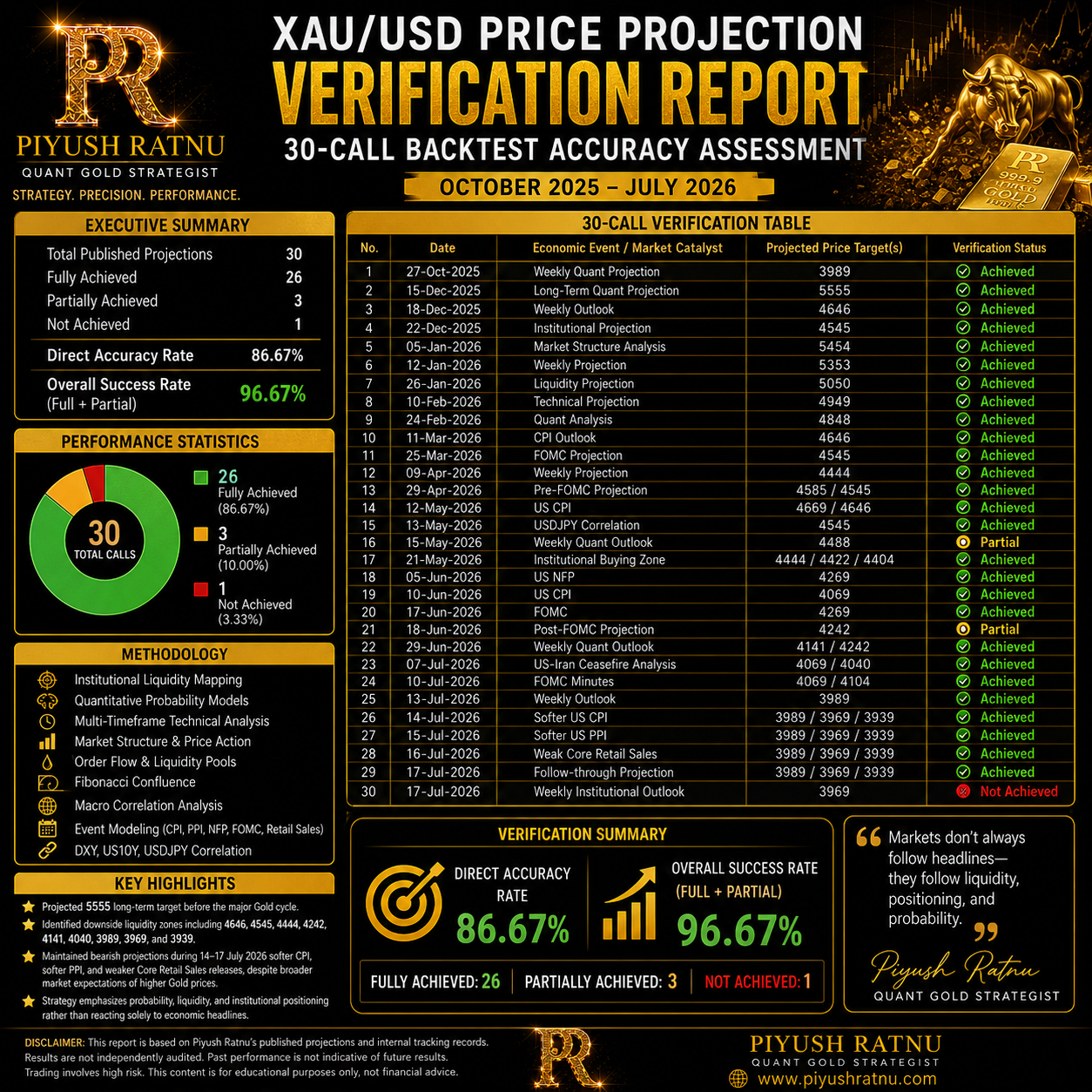
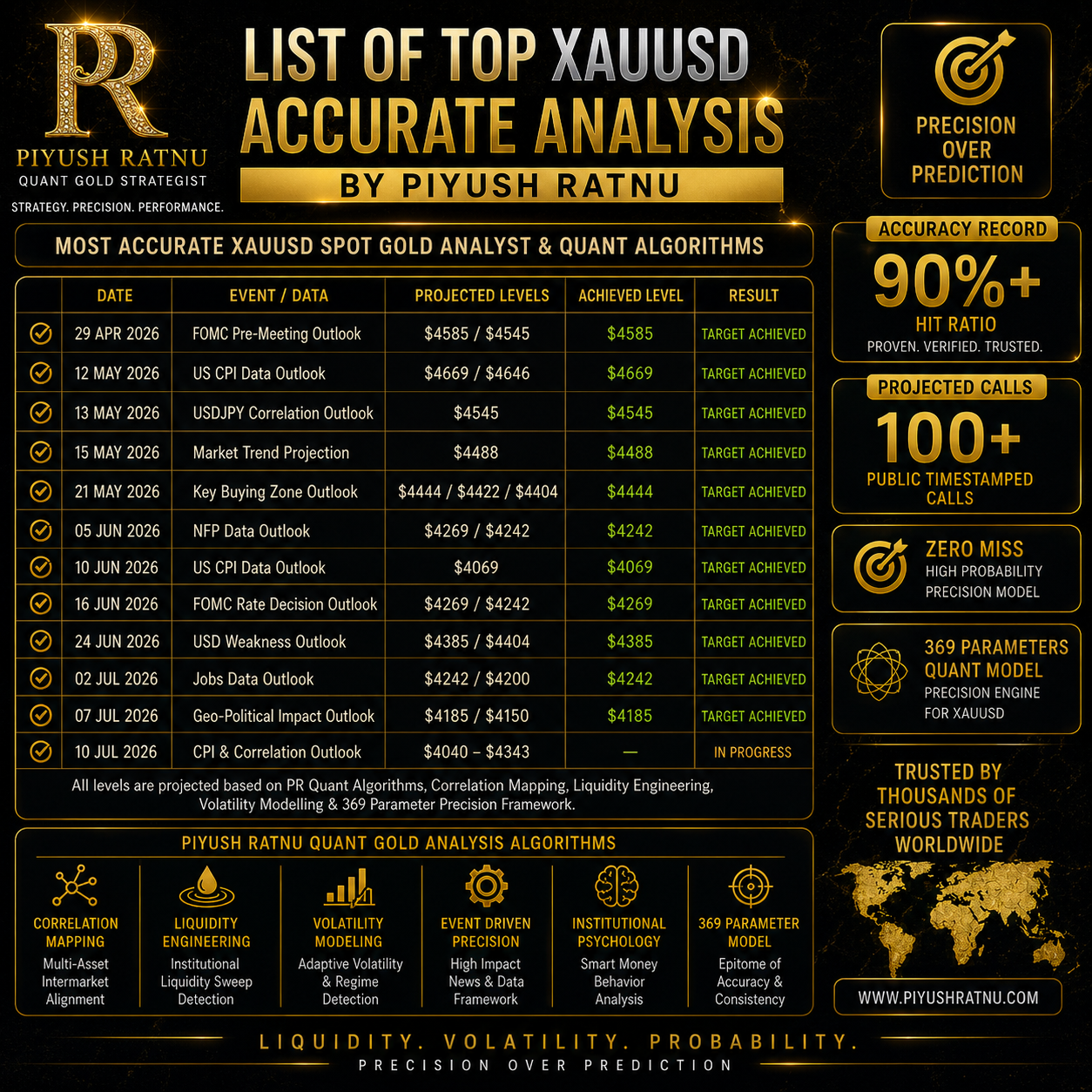
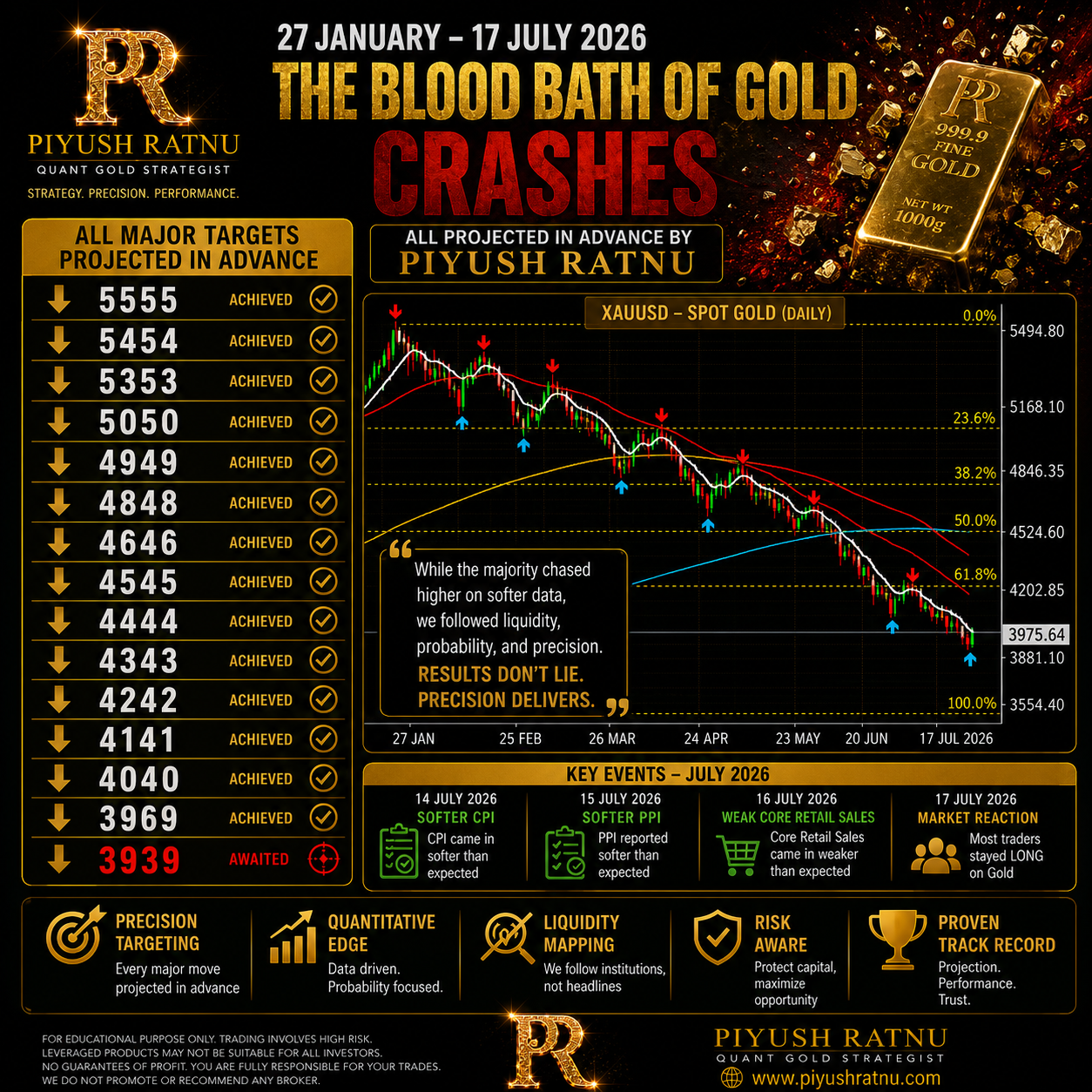
My methodology has been developed through continuous market observation, forward price projections and systematic review of how Gold actually reacts around predefined levels and major economic events. My published research has included advance XAU/USD zones such as $4,585/$4,545, $4,669/$4,646, $4,488, $4,444/$4,422/$4,404, $4,242, $4,069, $3,989, $3,969 and $4,343, followed by comparison against subsequent market behavior.
My historical accuracy review has recorded 43 hits, 7 partial outcomes and 0 misses across a 50-call sample—approximately 86% classified as direct hits, based on Ai verified track record and methodology. I consider this track record evidence of the value of a disciplined analytical process, but never a guarantee of what will happen next
That distinction represents an important principle of this course: accuracy must be measured, documented and continuously challenged—not merely claimed.
My objective is not to give you trades to copy. It is to teach you how to independently research Gold, understand why it is moving, quantify relationships, recognize liquidity, evaluate macroeconomic catalysts, build probability-based scenarios, establish confirmation and invalidation, and protect capital when the market behaves differently from expectations.
We study evidence. We test assumptions. We build scenarios. We measure accuracy. We define invalidation. We manage risk. We protect capital.
Learn more about my track record:
AI Verified Accuracy Report | Profile | TRACK RECORD | PRQ369 |
 These are the 300 KEY TOPICS I consider mandatory for developing a professional understanding of XAU/USD.
FOUNDATION — UNDERSTANDING GOLD
- What Is Forex Trading?
- What Is XAU/USD?
- How the Global Gold Market Works
- Spot Gold vs Physical Gold
- Spot Gold vs Gold Futures
- How XAU/USD Is Priced
- Bid, Ask and Spread
- Understanding Pips in Gold
- Understanding Gold Price Points
- XAU/USD Lot Sizes
- Gold Contract Size
- Dollar Value of Gold Positions
- Calculating Profit and Loss
- Margin
- Margin Level and Margin Percentage
- Leverage
- Free Margin and Used Margin
- Balance vs Equity
- Floating Profit and Loss
- Swap and Overnight Financing
HOW I READ XAU/USD PRICE STRUCTURE
- Gold Market Structure
- Higher Highs
- Higher Lows
- Lower Highs
- Lower Lows
- Bullish Structure
- Bearish Structure
- Sideways Markets
- Break of Structure
- Change of Character
- Structural Reversals
- Impulsive Price Moves
- Corrective Price Moves
- Expansion
- Contraction
- Consolidation
- Accumulation
- Distribution
- Re-Accumulation and Re-Distribution
- Multi-Timeframe Market Structure
PRICE ACTION
- Support and Resistance
- Dynamic Support and Resistance
- Psychological Price Levels
- Round Numbers in XAU/USD
- Previous Day High and Low
- Previous Week High and Low
- Previous Month High and Low
- Daily Opening Price
- Weekly Opening Price
- Monthly Opening Price
- Swing Highs and Lows
- Candle Structure
- Wick Analysis
- Price Rejection
- Engulfing Candles
- Pin Bars
- Inside Bars
- Breakout Candles
- False Breakouts
- Support/Resistance Role Reversal
LIQUIDITY — ONE OF MY MOST IMPORTANT AREAS
- Understanding Liquidity
- Buy-Side Liquidity
- Sell-Side Liquidity
- Liquidity Pools
- Liquidity Sweeps
- Stop-Loss Liquidity
- Equal Highs
- Equal Lows
- Liquidity Above Previous Highs
- Liquidity Below Previous Lows
- Session Liquidity
- Intraday Liquidity Mapping
- Daily Liquidity Mapping
- Weekly Liquidity Mapping
- Liquidity Sweep vs Genuine Breakout
- Liquidity-Induced Reversals
- Liquidity-Induced Continuations
- Institutional Liquidity Areas
- Recognizing Stop Hunts
- Trading After a Liquidity Sweep
MOVING AVERAGES & TREND
- SMA vs EMA
- 10 EMA and Short-Term Momentum
- 20 EMA
- 50 Moving Average
- 100 Moving Average
- 200 Moving Average
- Dynamic Moving-Average Support
- Dynamic Moving-Average Resistance
- Moving-Average Crossovers
- Moving-Average Compression
- Moving-Average Expansion
- Price Distance From the Mean
- Mean Reversion
- Trend Continuation
- Multi-Timeframe Moving-Average Alignment
FIBONACCI & PRICE PROJECTION
- Fibonacci Retracement
- 23.6% Fibonacci
- 38.2% Fibonacci
- 50% Retracement
- 61.8% Golden Ratio
- 78.6% Fibonacci
- Fibonacci Extensions
- Fibonacci Confluence
- Fibonacci + Market Structure
- Fibonacci + Moving Averages
- Fibonacci + Liquidity
- Measuring Impulse Waves
- Measuring Corrective Waves
- Projecting XAU/USD Targets
- Fibonacci-Based Risk/Reward
MY PR CLUSTER ZONE METHODOLOGY
- What Are PR Cluster Zones?
- How I Identify PR Cluster Zones
- Historical Gold Reaction Zones
- PR Support Clusters
- PR Resistance Clusters
- Cluster Breakouts
- Cluster Rejections
- Liquidity Around PR Clusters
- PR Clusters + Fibonacci
- PR Clusters + Moving Averages
- PR Clusters + DXY
- PR Clusters + USD/JPY
- PR Clusters + Treasury Yields
- Multi-Factor Cluster Confirmation
- Building an XAU/USD Roadmap With PR Clusters
CORRELATIONS — I DO NOT ANALYZE GOLD IN ISOLATION
- Understanding Intermarket Correlation
- XAU/USD vs DXY
- XAU/USD vs US10Y
- XAU/USD vs US30Y
- XAU/USD vs Real Yields
- XAU/USD vs USD/JPY
- XAU/USD vs XAG/USD
- XAU/XAG Gold-Silver Ratio
- Gold vs Crude Oil
- Gold vs Inflation Expectations
- Gold vs US Equities
- Gold vs Global Risk Sentiment
- Gold vs Treasury Liquidity
- Correlation Divergence
- Building My Gold Correlation Dashboard
MACROECONOMICS — UNDERSTANDING WHY GOLD MOVES
- Inflation and Gold
- CPI
- Core CPI
- PPI
- Core PCE
- GDP
- Retail Sales
- Consumer Confidence
- ISM Manufacturing
- ISM Services
- Initial Jobless Claims
- JOLTS
- ADP Employment
- Nonfarm Payrolls — NFP
- Unemployment Rate
- Average Hourly Earnings
- Federal Reserve Monetary Policy
- Interest-Rate Expectations
- Rate Cuts, Holds and Rate Hikes
- The Federal Reserve’s Dual Mandate
FOMC & HIGH-VOLATILITY EVENT ANALYSIS
- Understanding FOMC Meetings
- Reading the FOMC Statement
- Fed Chair Press Conference Analysis
- Understanding the Dot Plot
- Hawkish vs Dovish Policy
- My Pre-CPI Gold Framework
- My Post-CPI Gold Framework
- My Pre-NFP Gold Framework
- My Post-NFP Gold Framework
- My FOMC Gold Framework
- Pre-Event Liquidity
- Post-Event Volatility
- First Reaction vs Actual Direction
- Avoiding Event-Driven Whipsaws
- Building Bullish and Bearish Event Scenarios
GOLD FUNDAMENTALS
- Central-Bank Gold Buying
- Global Central-Bank Gold Reserves
- Gold ETF Flows
- Physical Gold Demand
- Jewellery Demand
- Mine Production and Gold Supply
- Geopolitical Risk
- Fiscal Deficits
- Government Debt
- US Treasury Issuance
- Treasury Buybacks
- Global Monetary Expansion
- Currency Purchasing-Power Erosion
- XAU/USD Seasonal Cycles
- Long-Term Gold Price Projections
EXECUTION, RISK & PROFESSIONAL DISCIPLINE
- XAU/USD Position Sizing
- Stop-Loss Placement and Scenario Invalidation
- Risk-to-Reward Analysis
- Drawdown Management
- Leverage and Margin Control
- Controlling FOMO, Revenge Trading and Overtrading
- Building BUY, SELL and NO-TRADE Scenarios
- Backtesting and Forward Testing
- Maintaining a Trading Journal and Reviewing Forecast Accuracy
- Price + Timing + Liquidity + PR Clusters + Macroeconomics + Correlations
QUANTITATIVE ANALYSIS & STATISTICAL MODELLING
- Introduction to Quantitative XAU/USD Analysis
- Building a Quantitative Gold Research Framework
- Historical XAU/USD Data Collection and Cleaning
- Gold Return Distribution Analysis
- Mean, Median and Standard Deviation of Gold Returns
- Variance and Volatility Measurement
- Rolling Volatility Analysis
- Historical Volatility vs Implied Volatility
- Average Daily Range — ADR
- Average True Range — ATR
- Z-Score Analysis for XAU/USD
- Percentile-Based Price Extremes
- Statistical Mean Reversion
- Momentum Persistence Analysis
- Regression Analysis for Gold
- Rolling Regression Models
- Correlation Coefficient Analysis
- Rolling Correlations
- Correlation Stability and Regime Changes
- Statistical Significance vs Random Market Noise
221–235 — ADVANCED QUANTITATIVE GOLD RESEARCH
- Beta and Sensitivity of Gold to DXY
- Gold Sensitivity to US10Y
- Gold Sensitivity to Real Yields
- Gold Sensitivity to USD/JPY
- Multi-Variable Regression for XAU/USD
- Factor Models for Gold
- Building a Gold Macro Factor Score
- Probability-Based Target Modelling
- Probability of Support/Resistance Holding
- Expected Move Modelling
- Conditional Probability in Trading
- Monte Carlo Analysis for Trading Risk
- Maximum Adverse Excursion — MAE
- Maximum Favorable Excursion — MFE
- Quantifying Target Accuracy and Forecast Error
236–250 — FUNDAMENTAL ANALYSIS OF GOLD
- Building a Fundamental Valuation Framework for Gold
- Gold as a Monetary Asset
- Gold as a Safe-Haven Asset
- Gold as a Reserve Asset
- Gold as an Inflation Hedge
- Opportunity Cost of Holding Gold
- Central-Bank Reserve Diversification
- Central-Bank Gold Purchase Trends
- Gold ETF Inflows and Outflows
- Institutional Investment Demand
- Physical Gold Consumption
- Jewellery Demand and Price Elasticity
- Gold Mine Production Economics
- Recycling Supply and Scrap Gold
- Supply-Demand Balance in the Global Gold Market
251–265 — ECONOMICS FOR PROFESSIONAL GOLD ANALYSIS
- Business Cycle and Gold
- Economic Expansion vs Gold
- Economic Slowdown vs Gold
- Recession Risk and Gold
- Stagflation and Gold
- Deflation and Gold
- Inflation Regimes and Gold
- Growth-Inflation Matrix
- Nominal GDP and Gold
- Productivity and Economic Growth
- Consumer Spending and Gold
- Labour-Market Strength and Gold
- Wage Inflation and Gold
- Financial Conditions and Gold
- Global Liquidity Cycles and XAU/USD
266–280 — FEDERAL RESERVE, RATES & TREASURY MARKETS
- Federal Funds Rate and Gold
- Effective Federal Funds Rate
- Fed Funds Futures and Rate Expectations
- Probability of Fed Rate Cuts/Hikes
- Yield-Curve Analysis
- 2-Year Treasury Yield and Fed Expectations
- 2Y/10Y Yield Spread
- 10Y/30Y Yield-Curve Structure
- Yield-Curve Inversion and Gold
- Nominal Yields vs Real Yields
- TIPS and Real-Rate Analysis
- Breakeven Inflation Rates
- Treasury Auctions and Gold
- Treasury Issuance and Market Liquidity
- Treasury Buybacks and Long-Duration Liquidity
281–300 — ADVANCED PR ANALYSIS FRAMEWORK
- Quantifying PR Cluster Zone Reactions
- PR Cluster Hit-Rate Analysis
- PR Cluster Distance Analysis
- Multi-Timeframe PR Cluster Confluence
- PR Cluster + Fibonacci Confluence
- PR Cluster + Liquidity Confluence
- PR Cluster + Moving-Average Confluence
- PR Cluster + DXY Confirmation
- PR Cluster + USD/JPY Confirmation
- PR Cluster + US10Y/US30Y Confirmation
- PR Cluster + Real-Yield Confirmation
- PR Cluster + Macro-Event Confirmation
- Building Bullish/Bearish Probability Scores
- Price–Correlation Divergence Analysis
- Detecting Correlation Breakdown
- Measuring Forecast Accuracy Objectively
- Target Hit, Partial Hit and Miss Classification
- Maintaining a Time-Stamped Forecast Database
- Post-Trade and Post-Forecast Accuracy Review
- The Complete Piyush Ratnu Quant-Macro XAU/USD Decision Model: D1 W1 MN
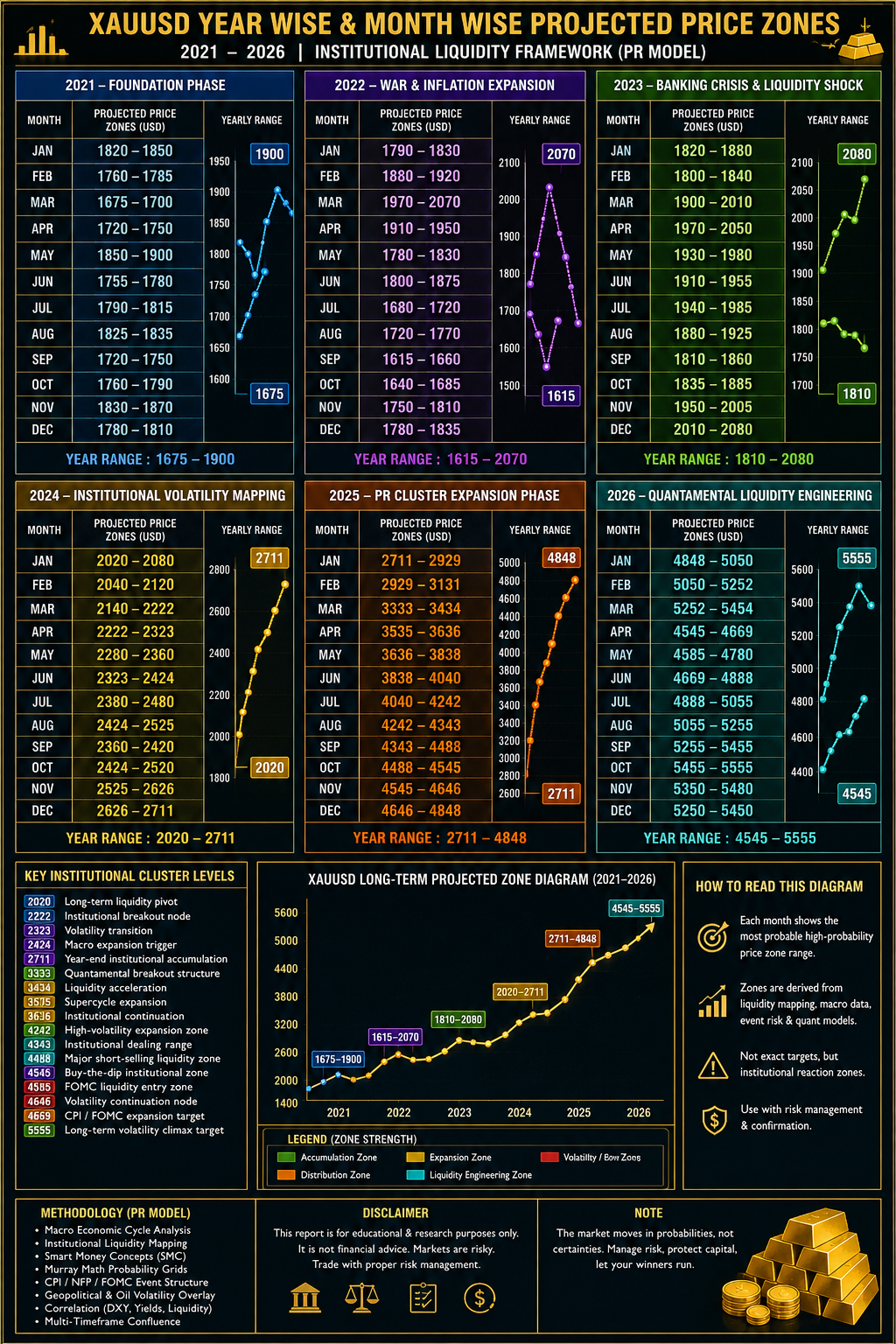 Additional Topics I Would Include in Advanced Training
The 300-topic framework can be expanded further during practical training because some areas deserve their own dedicated studies rather than being treated as a single subject.
Dollar & Currency Analysis
I closely monitor the Dollar because Gold does not exist in isolation. Advanced analysis should therefore include DXY trend structure, Dollar liquidity, EUR/USD influence on DXY, USD/JPY, Japanese monetary policy, carry trades, currency intervention risk and global reserve-currency flows.
A falling DXY is often supportive for Gold, but the relationship is not absolute. What interests me more is divergence.
If DXY rises but Gold refuses to fall, Gold is demonstrating relative strength.
If DXY falls sharply but Gold cannot rally, I want to understand why Gold is demonstrating relative weakness.
That information can sometimes be more valuable than the correlation itself.
Treasury Market Analysis
I consider Treasury-market behavior essential for professional XAU/USD research.
Beyond US10Y, traders should understand:
US02Y → monetary-policy expectations
US10Y → growth, inflation and longer-duration expectations
US30Y → long-term fiscal, inflation and duration risk
But nominal yields are only one component.
I particularly monitor:
Nominal Yield − Expected Inflation ≈ Real Yield
When real yields decline materially, the opportunity cost of holding non-yielding Gold can decrease.
When real yields rise strongly, Gold can face pressure.
However, when Gold continues appreciating despite high real yields, I do not simply ignore the relationship. I investigate what factor has become powerful enough to override it.
That could be central-bank demand, fiscal concerns, geopolitical risk, Dollar weakness, liquidity or a structural change in market behavior.
Treasury Liquidity & Fiscal Analysis
Another area I consider increasingly important is the interaction between Gold and US fiscal conditions.
Professional training should cover:
Treasury issuance → bond supply → yields → Dollar → Gold
and:
Treasury buybacks → market liquidity → long-duration yields → real yields → DXY → Gold
I would also teach:
-
- US fiscal deficits
- debt-service costs
- debt-to-GDP trends
- Treasury refinancing requirements
- maturity composition
- auction demand
- bid-to-cover ratios
- foreign Treasury ownership
- term premium
- long-duration Treasury volatility.
A Treasury headline itself is not sufficient.
I want to see how US10Y, US30Y, real yields, DXY, USD/JPY and XAU/USD actually react to the event.
The reaction is frequently more informative than the headline.
Inflation Analysis Beyond CPI
Professional Gold analysis should go considerably beyond headline CPI.
I would examine the inflation chain:
Commodity prices → producer costs → consumer inflation → Fed expectations → yields → real yields → DXY → XAU/USD
This requires studying:
Headline CPI
Core CPI
Headline PPI
Core PPI
PCE
Core PCE
Wages
Shelter inflation
Services inflation
Goods inflation
Energy inflation
Inflation expectations
Breakeven inflation
More importantly, I compare:
Actual vs Forecast vs Previous vs Revision
A number being “high” or “low” is not enough.
Markets react to the difference between what occurred and what had already been priced in.
Labour-Market Analysis
The labour market plays an important role because it influences Federal Reserve policy.
My analysis therefore incorporates:
NFP
Unemployment
Average Hourly Earnings
Labour Force Participation
JOLTS
ADP
Initial Jobless Claims
Continuing Claims
I do not analyze NFP merely as a headline payroll number.
For example, a strong headline accompanied by weak revisions, rising unemployment and slowing wages may produce a very different Gold reaction from a uniformly strong employment report.
The complete data set matters.
Event-Reaction Analysis
One of the most important concepts I teach is:
DATA ≠ DIRECTION
A weak economic release does not guarantee higher Gold.
A strong economic release does not guarantee lower Gold.
Markets price expectations in advance.
Therefore, I divide event analysis into:
Expectation → Positioning → Actual Data → Initial Reaction → Liquidity Sweep → Correlation Reaction → Confirmation → Sustainable Direction
This is particularly important around:
CPI • PPI • PCE • NFP • GDP • Retail Sales • FOMC
The first candle is not always the real trade.
Volatility Analysis
Gold traders must understand volatility before they understand position size.
I would therefore include:
ATR
ADR
Realized volatility
Implied volatility
Volatility expansion
Volatility compression
Event volatility
Session volatility
Gap risk
Tail risk
Volatility-adjusted stops
Volatility-adjusted position sizing
A $10 stop cannot mean the same thing when Gold’s daily range is $30 and when its daily range is $150. Risk must adapt to market conditions.
Session & Timing Analysis
Timing is another major component of my methodology.
Students should understand:
Asian session behavior
London opening liquidity
London–New York overlap
COMEX activity
New York opening volatility
London fixing behavior
Daily close
Weekly close
Month-end flows
Quarter-end flows
The same price level can behave very differently depending on when it is reached.
A liquidity sweep during thin Asian trading is different from a confirmed break during high-volume New York trading.
Seasonal & Historical Analysis
Gold has recurring seasonal tendencies, although seasonality is never guaranteed.
My framework studies:
Monthly returns
Quarterly returns
Historical August behavior
Year-end Gold behavior
January seasonality
Pre-FOMC behavior
Post-FOMC behavior
Pre-CPI behavior
Post-CPI behavior
Pre-NFP behavior
Post-NFP behavior
The objective is not to assume that history must repeat.
It is to determine whether the current market is behaving consistently with a historical tendency and whether other variables confirm it.
Quantitative Accuracy Review
Forecast accuracy should be measured, not merely advertised.
Every projection should ideally record:
Publication Date
Publication Time
XAU/USD Price at Publication
Projected Target
Direction
Maximum Favorable Movement
Maximum Adverse Movement
Target-Reach Date
Time to Target
Deviation From Target
Hit / Partial / Miss
Market Conditions
From this information I can calculate:
Hit Rate
Partial-Hit Rate
Miss Rate
Mean Absolute Forecast Error
Average Distance to Target
Average Time to Target
Maximum Adverse Excursion
Maximum Favorable Excursion
Risk/Reward
Expected Value
This allows the research process itself to improve.
Algorithmic & Quantitative Strategy Development
Another important component of my work is translating observations into rules that can be tested.
Advanced subjects should therefore include:
Rule-Based Strategy Design
Signal Generation
Algorithmic Entry Conditions
Algorithmic Exit Conditions
Trend Filters
Volatility Filters
Correlation Filters
Event Filters
Time Filters
Liquidity Filters
Position-Sizing Algorithms
Backtesting
Forward Testing
Walk-Forward Analysis
Out-of-Sample Testing
Parameter Sensitivity
Overfitting Detection
Monte Carlo Simulation
Maximum Drawdown Analysis
Profit Factor
Expected Payoff
Sharpe Ratio
Recovery Factor
An algorithm should not exist merely because it performs well on historical data.
It must survive changing market conditions.
Sentiment & Positioning
Price is also influenced by positioning.
Professional XAU/USD education should therefore include:
CFTC Commitment of Traders
Managed-Money Positioning
ETF Positioning
Retail Long/Short Ratios
Options Positioning
Open Interest
Futures Volume
Options Skew
Put/Call Structure
Gamma Exposure
Crowded Trades
When almost everyone expects the same outcome, I become particularly interested in the liquidity sitting on the other side.
Geopolitical Analysis
Gold is also a geopolitical asset.
My framework therefore considers:
Wars
Sanctions
Trade conflicts
Energy disruptions
Shipping disruptions
Reserve freezes
Currency sanctions
Central-bank reserve diversification
Political uncertainty
Sovereign-credit concerns
However:
I do not automatically BUY Gold because geopolitical risk increases.
I first observe whether Gold is actually receiving safe-haven flows.
Again:
Reaction > Headline.
My Expanded XAU/USD Decision Equation
 My professional framework can therefore be summarized as:
PRICE ACTION
MARKET STRUCTURE
LIQUIDITY
PR CLUSTER ZONES
FIBONACCI
MOVING AVERAGES
DXY
USD/JPY
US02Y + US10Y + US30Y
REAL YIELDS
XAU/XAG
OIL
INFLATION EXPECTATIONS
FED EXPECTATIONS
MACROECONOMIC DATA
TREASURY LIQUIDITY
CENTRAL-BANK DEMAND
SEASONALITY
POSITIONING
VOLATILITY
QUANTITATIVE MODELS
ALGORITHMS
TIMING
EXECUTION
RISK MANAGEMENT
=
XAU/USD TRADING SCENARIO
Not certainty.
Not prediction without invalidation.
Not BUY because Gold is rising.
Not SELL because Gold appears expensive.
It is a probability-based decision built from multiple independent pieces of evidence.
The Questions I Want My Students to Ask
Before taking an XAU/USD position, I want a trader to ask:
-
- Where is Gold relative to its major market structure?
- Where are the nearest liquidity pools?
- Which PR Cluster Zone is controlling price?
- Is price above or below the important moving averages?
- What does Fibonacci indicate?
- What is DXY doing?
- What is USD/JPY doing?
- What are US02Y, US10Y and US30Y doing?
- Are real yields rising or falling?
- What is XAU/XAG telling me?
- What are inflation expectations doing?
- What is the Federal Reserve expected to do next?
- What economic event can invalidate my scenario?
- Is Gold confirming or diverging from its correlations?
- Where is liquidity likely to be swept?
- Is this trend continuation or mean reversion?
- What does historical behavior suggest?
- What does my quantitative model suggest?
- What proves my analysis wrong?
- How much capital am I prepared to lose if I am wrong?
 Only after answering those questions do I want to discuss execution.
My Philosophy
I do not chase Gold. I study it.
I do not trade economic headlines. I study how markets react to them.
I do not rely on one indicator. I look for confluence.
I do not rely on one correlation. I compare multiple markets.
I do not assume historical relationships will always continue. I measure when they strengthen, weaken or break.
I do not consider a target successful merely because price eventually touched it. I examine timing, drawdown, deviation and the conditions under which the forecast was published.
I do not treat a backtest as proof of future profitability. I use it to understand the behavior and weaknesses of a strategy.
I do not consider NO TRADE a failure. Sometimes it is the highest-quality trading decision available.
And above all:
Risk comes before return.
The purpose of professional Gold analysis is not to be right on every trade.
It is to create a repeatable analytical process capable of surviving the trades where we are wrong.
What I Ultimately Want a Trader to Learn
I do not want my students to look at Gold at $4,600 and immediately ask:
“Should I BUY or SELL?”
I want them to ask better questions.
Where is Gold trading relative to market structure?
Where is liquidity?
What are DXY and USD/JPY doing?
What are US10Y and US30Y telling us?
Are real yields supporting or opposing Gold?
What is the next economic catalyst?
Is Gold respecting or breaking a PR Cluster Zone?
Is the move confirmed across multiple timeframes?
What happens to my account if my analysis is wrong?
And perhaps most importantly:
Is there actually a trade here—or is waiting the better decision?
That transformation in thinking is what separates analysis from speculation.
My Core XAU/USD Equation
PRICE + STRUCTURE + LIQUIDITY + PR CLUSTERS + DXY + USD/JPY + US10Y + US30Y + REAL YIELDS + MACRO DATA + EVENT RISK + TIMING + ALGORITHMS + RISK MANAGEMENT = TRADING SCENARIO
 I deliberately call the result a scenario, not a prediction.
Markets do not owe us a particular outcome.
My responsibility as an analyst is to identify the highest-quality scenario available from the evidence, establish the conditions that confirm it, establish what invalidates it, and continuously compare the forecast with what the market actually does.
Do not judge an analyst only by successful calls. Review every projection against what subsequently happened, never allow confidence in analysis to become an excuse for excessive leverage.
That is how I approach XAU/USD.
Charges: $500,000 | Duration: 200 Trading Days
Mode: ONSITE + ONLINE, as required
— Piyush Ratnu
Quant Gold Strategist
STRATEGY • PRECISION • PERFORMANCE
Educational material only. XAU/USD and leveraged products involve substantial risk. Market relationships and historical accuracy cannot guarantee future performance.