Performance Through Precision: Building ROI with Controlled Risk
By Piyush Ratnu | Quant Gold Strategist
My approach to trading has always been based on a simple principle: performance should not be measured by profit alone. Sustainable trading requires a combination of return generation, disciplined execution, capital protection and careful management of drawdown. The performance period from 1 January 2025 to 3 September 2026 provides an example of this philosophy in practice.
CLIENT TESTIMONIAL and DETAILED STATEMENT AVAILABLE SUBJECT TO FACE TO FACE MEETING.
$50,000 Capital — $49,223.86 Net Profit
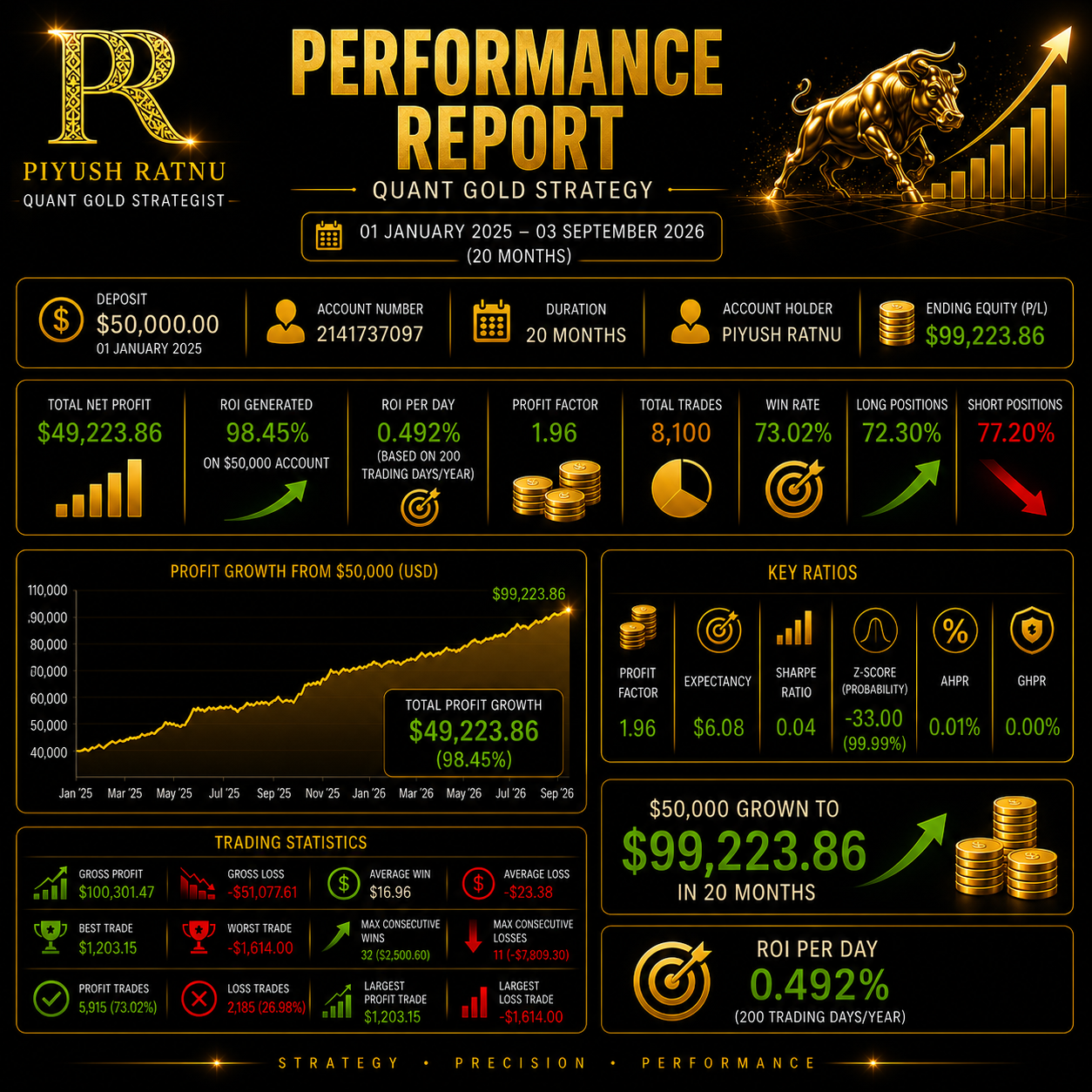 Starting with a $50,000 account, the strategy generated $49,223.86 in net trading profit, representing approximately 98.45% ROI during the stated period.
For me, the important aspect is not simply the percentage return. The objective is to generate ROI through a repeatable trading process rather than depending on one or two exceptionally large positions.
The account recorded 8,100 trades, with 73.02% profitable trades and a profit factor of 1.96. This suggests that the overall result was distributed across a substantial trading sample rather than being represented by a handful of isolated outcomes.
ROI with Drawdown Control
High ROI becomes considerably less meaningful when it requires disproportionate leverage or uncontrolled drawdown. My focus is therefore on the relationship between return and risk, rather than return in isolation.
The underlying report from which these statistics were derived recorded maximal drawdown of approximately 15.96% during the measured sample. Against the reported 98.45% return, this provides important context for evaluating the strategy.
The goal is straightforward:
Generate ROI → control exposure → manage adverse movement → protect capital → compound performance.
No trading system can eliminate drawdown, and attempting to do so can itself create unrealistic expectations. Instead, my objective is to keep risk measurable and controlled while allowing profitable opportunities to contribute progressively to account growth.
Consistency Across Thousands of Trades
The trading statistics provide another important perspective. Of the 8,100 trades, approximately 5,915 were profitable, producing the reported 73.02% win rate.
The strategy also recorded a $100,301.47 gross profit against $51,077.61 gross loss, resulting in a 1.96 profit factor.
These numbers matter because accuracy alone does not determine whether a strategy is profitable. Position sizing, average loss, profit extraction, exposure and the ability to recover from adverse periods are equally important.
My emphasis remains on executing a defined methodology rather than attempting to predict every fluctuation in XAU/USD.
Focused ROI Rather Than Aggressive Risk
Trading Gold can involve exceptional volatility, particularly around NFP, CPI, FOMC decisions, Treasury-yield movements and rapid changes in the U.S. Dollar. A strategy therefore needs to survive adverse price movements as well as participate in profitable ones.
My framework focuses on structured price zones, liquidity behaviour, correlations and systematic execution. The objective is not maximum leverage. It is capital efficiency.
The performance shown here represents that philosophy: a $50,000 starting account generating $49,223.86 in net trading profit, while maintaining a structured approach to exposure and drawdown.
Ultimately, professional trading is not about one successful trade or one exceptional month. It is about producing measurable results repeatedly while keeping risk under control.
Strategy. Precision. Performance.
Past performance does not guarantee future results. Leveraged trading involves substantial risk and may result in losses.