XAU/USD Below $4,000: Why Gold Is Falling Despite a Weaker Dollar and Lower Treasury Yields
The Gold–Dollar Correlation Breakdown: Strong US Growth, Persistent Inflation, Federal Reserve Tightening Risks and the Upcoming US Midterm Elections
By Piyush Ratnu | Quant Gold Strategist
Global Macroeconomics • Quantitative Analysis • XAU/USD Market Intelligence
1. The Gold Paradox: When Traditional Correlations Stop Working
Gold has extended its decline below the psychologically significant $4,000 threshold, even as the US Dollar Index (DXY) and US Treasury yields move lower. Under conventional macroeconomic relationships, these conditions would ordinarily provide support to gold prices.
Historically, XAU/USD tends to exhibit an inverse relationship with the US Dollar. A weaker dollar makes gold less expensive for investors holding other currencies, potentially supporting international demand. Similarly, declining Treasury yields generally reduce the opportunity cost of holding a non-interest-bearing asset such as gold.
However, these relationships are neither permanent nor mechanically reliable.
The simultaneous decline in gold, the dollar and bond yields suggests that other market forces are dominating the traditional correlation structure.
For a quantitative gold strategist, this divergence is important. It indicates that traders must evaluate the underlying macroeconomic regime rather than rely exclusively on the direction of DXY or nominal Treasury yields.
2. Strong US GDP Growth Reinforces the Economic Resilience Narrative
The latest US economic figures indicate that the economy continues to demonstrate considerable resilience.
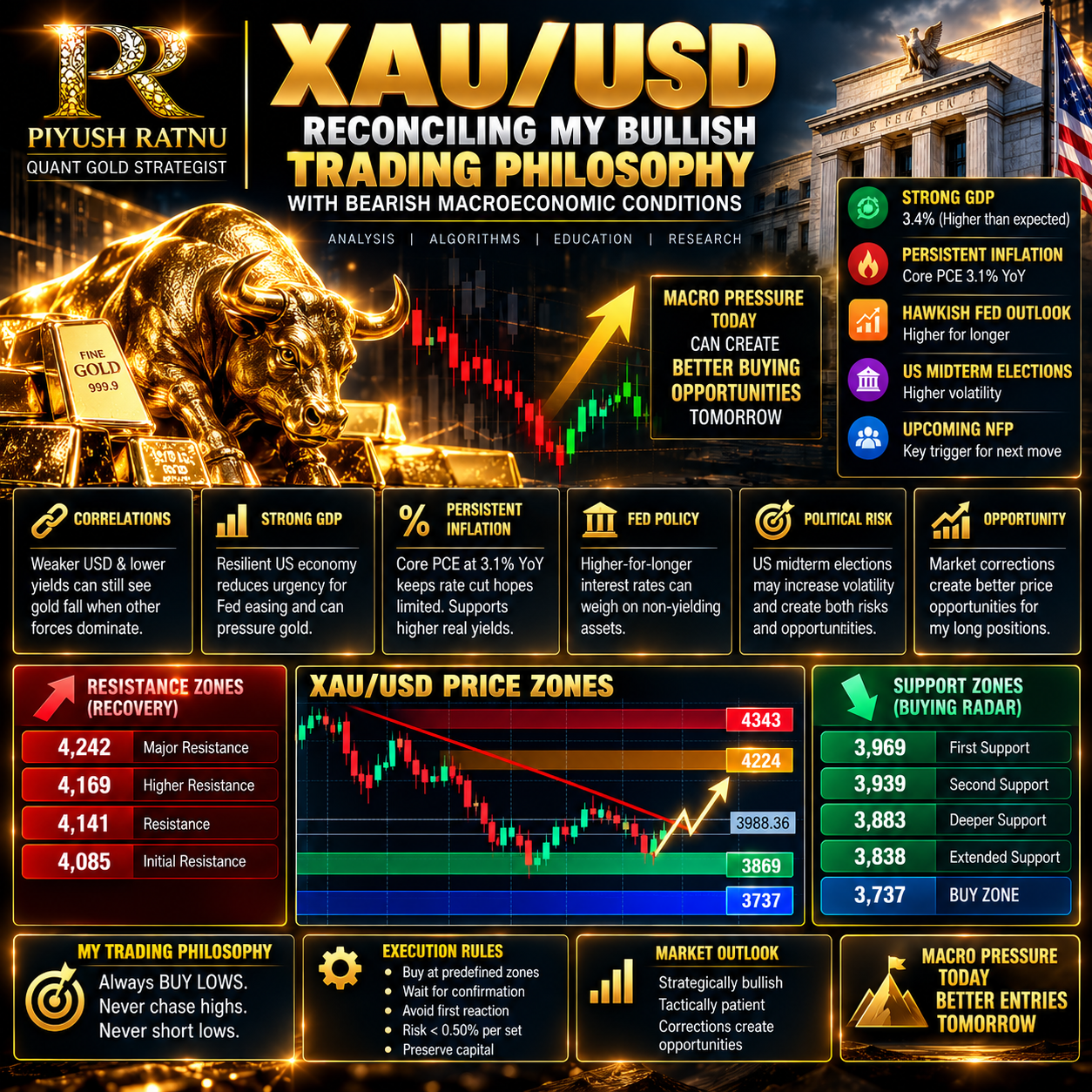
According to the reported release, US third-quarter GDP expanded by 3.4%, exceeding market expectations.
Stronger-than-anticipated economic growth carries significant implications for monetary policy and gold valuations.
When economic activity remains robust, the Federal Reserve has less immediate pressure to support growth through monetary easing. Strong output, resilient employment conditions and sustained consumer demand can allow policymakers to maintain restrictive interest rates for longer.
From the perspective of XAU/USD, stronger growth can therefore create a bearish fundamental influence, particularly when it strengthens expectations of future monetary tightening.
Nevertheless, strong GDP does not automatically cause gold prices to decline. The actual response depends on how much of the economic strength was already anticipated and how bond markets adjust their expectations for real interest rates.
3. Core PCE Inflation: Persistent Price Pressures Complicate the Fed’s Outlook
The Federal Reserve’s preferred inflation indicator, the Core Personal Consumption Expenditures Price Index (Core PCE), remains a central consideration in assessing the direction of US monetary policy.
The reported September figures indicate:
- Core PCE YoY: 3.1%, matching market expectations.
- Previous annual reading: 3.0%.
- Core PCE MoM: 0.3%, consistent with forecasts and the previous reading.
Although inflation did not exceed consensus expectations, the acceleration in the annual measure indicates that underlying price pressures remain elevated.
This distinction matters.
An inflation reading that matches expectations may produce a relatively muted immediate market reaction, but persistent inflation can still influence the Federal Reserve’s medium-term policy outlook.
Strong economic growth combined with stubborn inflation reduces the urgency for monetary easing and can strengthen the case for maintaining restrictive financial conditions.
For gold, the resulting pressure is most significant when markets begin pricing higher future real interest rates.
4. Why Gold Can Decline Even When Treasury Yields Fall
One of the most common analytical mistakes in gold trading is assuming that falling nominal Treasury yields must produce an immediate rise in XAU/USD.
Gold is generally more sensitive to real yields, inflation expectations, monetary policy expectations and investment flows than to nominal yields alone.
The relationship can be expressed as:
Real Yield ≈ Nominal Treasury Yield − Expected Inflation
Consequently, a decline in nominal yields does not necessarily imply that real yields are falling.
If inflation expectations decline faster than nominal yields, real yields can increase, potentially creating additional pressure on gold.
Other factors may also explain the divergence, including institutional profit-taking, leveraged-position liquidation, portfolio rebalancing, technical breakdowns and shifts in investor demand for liquidity.
Therefore, a simultaneous decline in DXY, US Treasury yields and gold should not automatically be interpreted as a bullish buying opportunity.
It should instead trigger a broader investigation into the drivers of price discovery.
5. Federal Reserve Policy: The Risk of Higher-for-Longer Interest Rates
The combination of stronger economic growth and persistent inflation presents a challenging environment for monetary policymakers.
A resilient economy reduces the immediate need for stimulus, while elevated inflation can discourage premature interest-rate reductions.
Under these conditions, the Federal Reserve may maintain restrictive policy for longer than markets previously anticipated.
A more hawkish policy outlook can support future real yields and influence the relative attractiveness of non-yielding assets.
For XAU/USD, the important transmission mechanism is:
Strong GDP + Persistent Inflation → Hawkish Fed Expectations → Potentially Higher Real Yields → Downward Pressure on Gold
However, this sequence is conditional. Actual market movements depend on expectations, the Fed’s communication and the broader investment environment.
6. US Midterm Elections: Political Uncertainty Adds Another Layer of Volatility
Attention is increasingly shifting toward the upcoming US midterm elections and their potential implications for fiscal policy, economic regulation, government spending and geopolitical relations.
Political uncertainty can influence gold through several competing channels.
A contested or unexpectedly disruptive election outcome may increase demand for defensive assets, potentially supporting gold.
Conversely, an outcome perceived as favorable for economic growth, fiscal stability or the US Dollar may initially reduce defensive demand.
Importantly, political uncertainty does not guarantee a gold rally.
The ultimate response depends on how election developments influence the dollar, Treasury yields, equity-market risk appetite and expectations for future fiscal and monetary policy.
The election date referenced in the supplied market commentary should be independently confirmed before publication.
7. October NFP: The Next Major Test of US Economic Strength
Following the GDP and inflation releases, attention will turn toward US employment indicators, particularly the October Nonfarm Payrolls report.
Employment data can materially influence expectations for the Federal Reserve’s next policy decisions.
A stronger-than-expected NFP report, accompanied by resilient wage growth, could reinforce the argument for restrictive monetary policy and increase pressure on gold.
A weaker report could encourage expectations of monetary easing and potentially support XAU/USD through lower real yields and a softer dollar.
However, the market reaction will depend on the combined interpretation of payroll growth, unemployment, wages and revisions to previous data.
For this reason, I prefer evaluating the complete employment report rather than trading solely on the headline payroll number.
8. XAU/USD Quantitative Price Map: Key Support and Resistance Zones
With gold trading below $4,000, the immediate technical structure requires careful monitoring.
My focus remains on predefined price clusters rather than attempting to predict every short-term fluctuation.
Downside Price Zones — Potential Support
| Price zone | Technical significance |
|---|---|
| $3,969 | First downside reference |
| $3,939 | Secondary support and potential liquidity area |
| $3,883 | Deeper support cluster |
| $3,838 | Extended downside reference |
A sustained decline below $3,969 could increase the relevance of $3,939, followed by $3,883 and $3,838 if selling pressure persists.
These are monitoring levels, not guarantees that price will reverse.
Upside Price Zones — Potential Resistance
| Price zone | Technical significance |
|---|---|
| $4,085 | Initial recovery resistance |
| $4,141 | Secondary upside objective |
| $4,169 | Higher resistance cluster |
| $4,242 | Extended bullish recovery objective |
A sustained recovery above $4,085 could improve the short-term technical outlook and expose $4,141 and $4,169.
A broader recovery toward $4,242 would require stronger bullish acceptance and supportive macroeconomic conditions.
9. My Trading Philosophy: Always Buy Lows, Never Chase Price
My approach to XAU/USD remains focused on identifying favorable buying opportunities near predefined lower price clusters.
However, buying lows does not mean purchasing every decline.
The distinction between a temporary correction and a sustained bearish breakdown is essential.
I monitor liquidity behavior, higher-timeframe market structure, real yields, DXY, USD/JPY and the market’s response to major economic releases before evaluating an entry.
My execution principles remain unchanged:
- Buy only at carefully selected price zones.
- Avoid chasing the first reaction to economic data.
- Seek structural confirmation where required.
- Avoid oversized positions and uncontrolled averaging.
- Keep risk below 0.50% per set of three buy-zone trades.
- Prioritize capital preservation when the expected setup fails.
10. Final Outlook: Macroeconomic Divergence Demands Greater Precision
Gold’s decline despite a weaker US Dollar and lower Treasury yields demonstrates why single-variable correlation models are insufficient during periods of economic and political uncertainty.
The current environment combines resilient US growth, persistent inflation, uncertainty over the Federal Reserve’s policy trajectory and the possibility of increased volatility surrounding employment data and political developments.
For XAU/USD, the immediate analytical focus remains on the downside clusters at $3,969, $3,939, $3,883 and $3,838, while the upside recovery map includes $4,085, $4,141, $4,169 and $4,242.
My conclusion: When traditional correlations diverge, disciplined price selection, macroeconomic interpretation and controlled risk become more important than directional conviction.
I will continue to focus on buying predefined lows rather than chasing temporary recoveries.
Piyush Ratnu
Quant Gold Strategist
Analysis • Algorithms • Education • Research
STRATEGY • PRECISION • PERFORMANCE
Disclaimer: This article presents conditional market analysis for educational purpose only. It does not constitute a guarantee of future performance or personalized investment advice.